
When designing a reliable power distribution system,engineers often ask:what is the difference between ATS and STS?Both devices transfer loads between two power sources,but they operate in fundamentally different ways.Understanding ATS and STS is essential for choosing the right solution for your application.
This article explains the similarities,key differences,and typical use cases of automatic transfer switches(ATS)and static transfer switches(STS)in a clear,objective manner.
Similarities Between ATS and STS
Before diving into differences,let’s look at what ATS and STS have in common:
- Dual power source management–Both devices connect a critical load to a primary source and automatically transfer it to a secondary source if the primary source fails.
- Backup power integration–Both work with generators,UPS systems,or utility feeders to ensure continuous power supply.
- Automatic operation–No manual intervention is required during a transfer event(though ATS may have longer delays).
These similarities often confuse specifiers.However,the internal technology and performance differ significantly.

Key Differences:ATS vs STS
The core difference between ATS and STS lies in switching technology and transfer time.
| Feature | ATS (Automatic Transfer Switch) | STS (Static Transfer Switch) |
|---|---|---|
| Switching element | Electromechanical (contactors or circuit breakers) | Solid-state (thyristors / SCRs) |
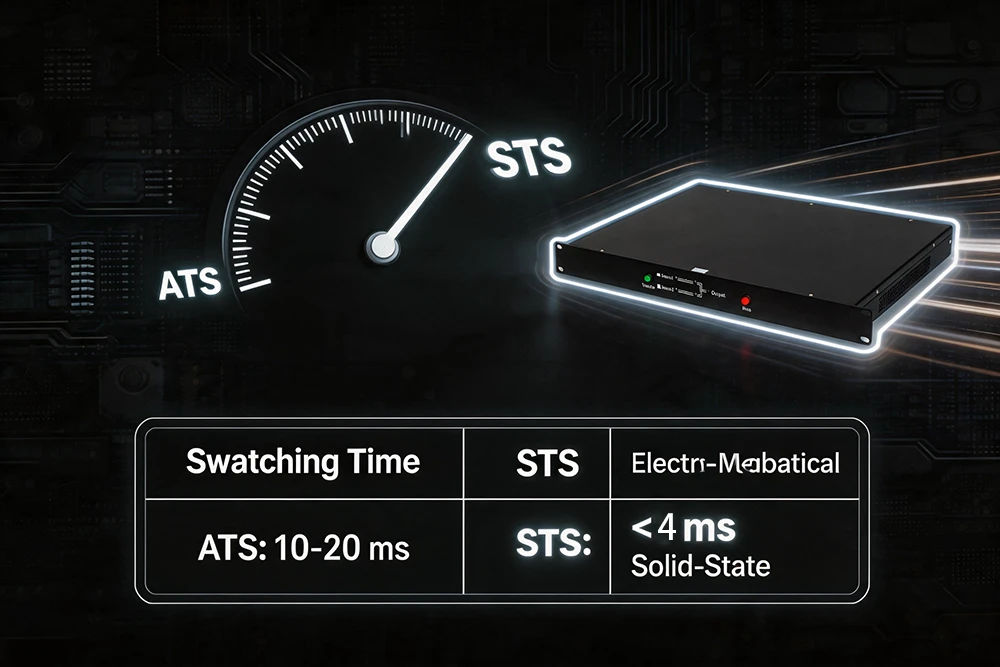
| Transfer time | 100–2000 milliseconds (typical 0.5–3 seconds) | 2–10 milliseconds (sub-cycle) |
| Mechanical wear | Yes – contacts wear over time | No moving parts, longer electrical life |
| Arc generation | Causes contact erosion | No arcs; silent switching |
| Voltage/current sensing | RMS detection (slower) | Peak or fast RMS (instantaneous) |
| Cost | Lower upfront cost | Higher upfront cost |
| Typical application | Motors, lighting, HVAC, general loads | Servers, PLCs, medical equipment, data centers |
Transfer Speed–The Most Critical Difference
- ATS uses mechanical relays.The switch physically moves contacts from one source to another,causing a break in power.This“break-before-make”action takes at least 50–100 ms for fast ATS models,but usually several hundred milliseconds to seconds(depending on under-voltage delay settings).
- STS uses silicon-controlled rectifiers(SCRs).It can turn off one source and turn on the other within half a cycle of AC power–typically 4–8 ms for 60 Hz systems.Many loads do not even“see”the transfer.
Load Compatibility
- ATS tolerates inrush currents from motors and transformers well because mechanical contacts can handle overloads temporarily.
- STS is more sensitive to overloads or short circuits.Protection coordination must be carefully designed,often using fast fuses instead of circuit breakers.
When to Use ATS vs STS–Which Is More Suitable?
Use an ATS when:
- The load can tolerate a power interruption of 0.5 to 3 seconds.
- Budget is a primary concern.
- The load includes large motors,compressors,heaters,or lighting.
- You need a simple,rugged device for industrial or building applications.
Examples:Manufacturing plants,commercial buildings,residential backup,pumping stations.
Use an STS when:
- The load is voltage-sensitive and cannot tolerate any break longer than 10 ms.
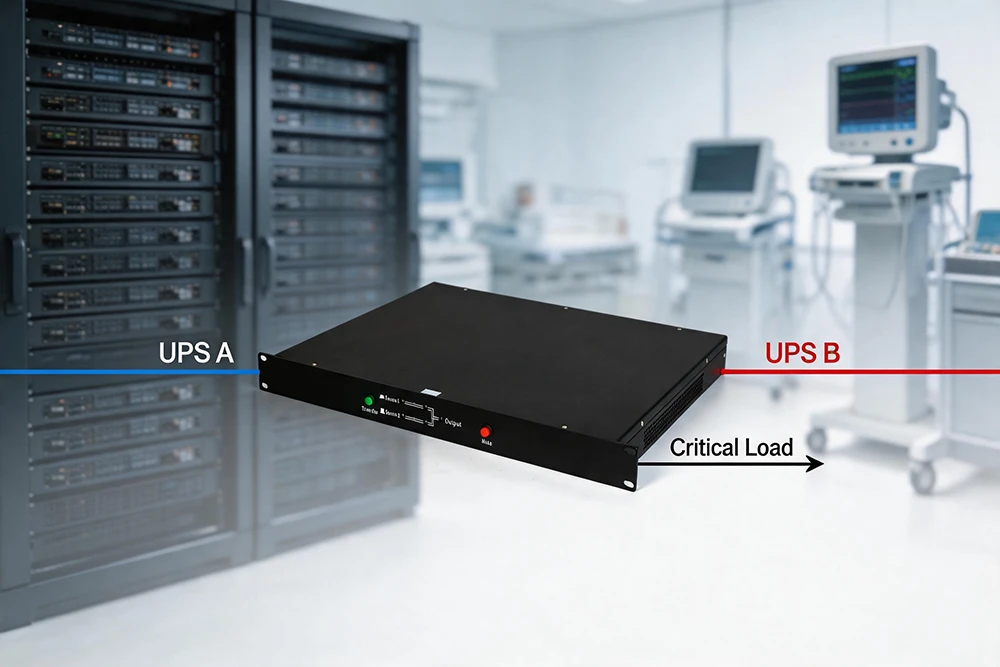
- You have two utility feeds or UPS outputs that are synchronized(or within phase tolerance).
- You are protecting IT equipment,medical imaging devices,or process controls.
Examples:Data centers,server rooms,semiconductor fabs,hospital operating rooms,financial transaction systems.
If your loads are purely IT or sensitive electronics,an STS is mandatory.For general power distribution,an ATS is both sufficient and cost-effective.
Summary Table–ATS and STS Differences at a Glance
| Aspect | ATS | STS |
|---|---|---|
| Transfer speed | Slow (0.5–3 sec) | Fast (2–10 ms) |
| Technology | Mechanical | Solid-state |
| Lifespan | Limited contact cycles | Very high (no wear) |
| Cost | Low–medium | Medium–high |
| Load type | All types (inductive, resistive) | Resistive + electronic (limited inrush) |
| Synchronization required | No | Yes (two in-phase sources recommended) |
Conclusion–What Is the Difference Between ATS and STS in Practice?
To summarize what is the difference between ATS and STS:ATS is a slower,mechanical,cost-effective switch for general loads that can tolerate short outages.STS is an ultra-fast,solid-state switch for mission-critical loads that require seamless source transfer.
Choosing between ATS and STS depends entirely on your load’s sensitivity to interruption and your budget.Many facilities use both:ATS for building services(HVAC,lighting)and STS for server racks or production lines.
For projects requiring high-performance static transfer switches,Voltruc’s STS series offers excellent build quality and fast delivery,ensuring reliable sub-cycle switching for your most sensitive equipment.Whether you need a standard unit or a customized solution,Voltruc provides both quality and lead‑time assurance.