
What Is a Parallel Inverter?
A parallel inverter is a power conversion system in which two or more inverters are connected together to operate simultaneously,sharing a common load.In this configuration,each inverter converts DC power from a battery or solar array into AC power independently,and all inverters contribute to the total power output delivered to the load.Unlike a single high-capacity inverter,a parallel inverter system distributes the workload across multiple smaller units,operating in sync to provide higher total power capacity while maintaining a stable voltage output.
The key principle behind a parallel inverter system is load sharing—each module takes a proportional share of the total current demanded by the load.This approach reduces current stress on individual inverters,lowers the risk of system failure,and enables flexible capacity expansion.
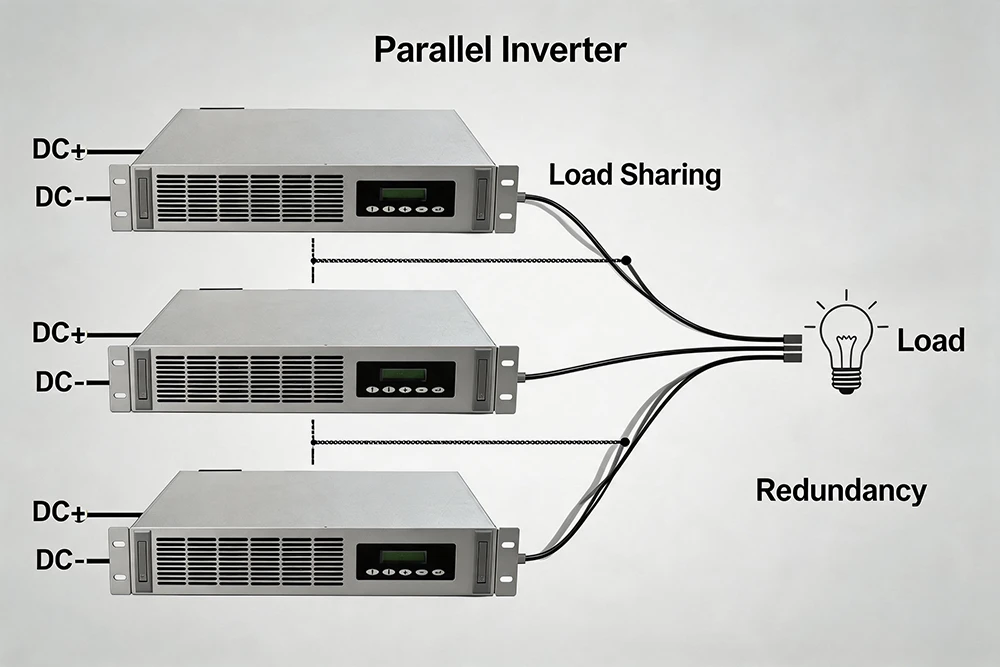
How It Differs from Series Inverters
To fully understand what a parallel inverter is,it helps to compare it with series inverter configurations:
- Parallel Inverters:Multiple inverters are connected side by side,each doing DC-to-AC conversion independently.They increase total current while keeping voltage the same,making them ideal for high-current,high-power applications.
- Series Inverters:Inverters are connected end to end,with one inverter’s output feeding into the next.They increase total voltage while keeping current the same,suitable for high-voltage,low-current applications.
The most significant advantage of parallel inverters for mission-critical systems is redundancy—if one inverter module fails,the remaining modules continue to supply power,ensuring uninterrupted operation.In contrast,a single point of failure in a series configuration can bring the entire system down.
Why Choose a Parallel Inverter System
Using parallel inverters instead of a single large inverter offers several compelling benefits:
- Scalability:You can start with a modest capacity and add more inverter modules as energy demand grows,without replacing the entire system.
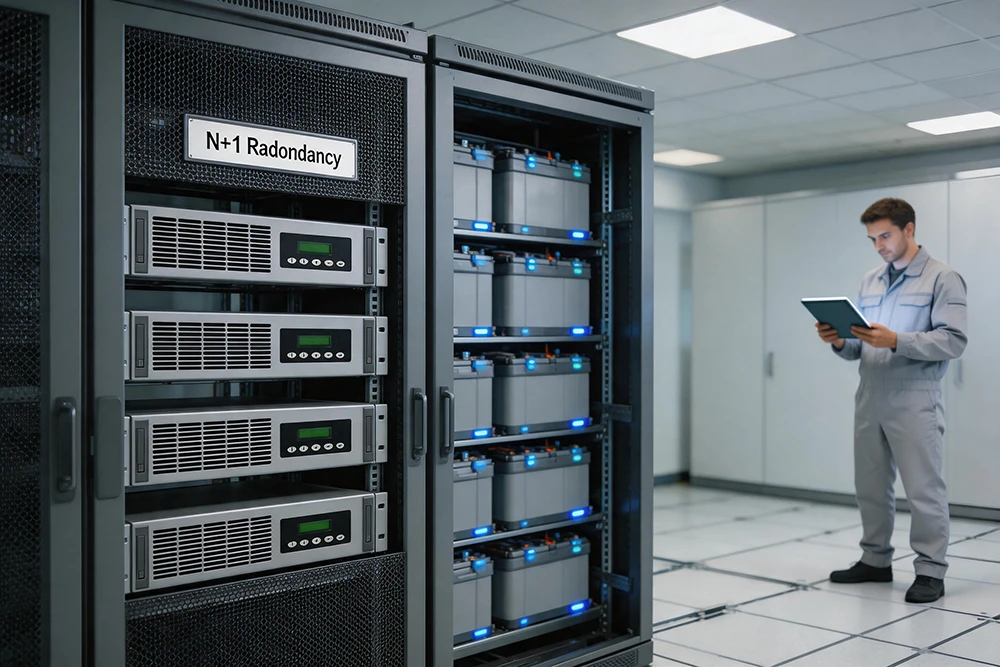
- Redundancy and Reliability:Parallel configuration enables N+1 redundancy—having one extra module beyond what is required to support the full load.If any module fails,the others take over seamlessly.
- Flexibility:System configuration becomes highly adaptable,allowing users to match power supply precisely to changing needs.
- Cost Efficiency:Modular design reduces upfront costs and shortens development cycles compared to designing a custom high-capacity inverter.
Applications of Parallel Inverters
Parallel inverter systems are used across a wide range of industries and use cases,including:
1.Residential and Commercial Solar Power Systems
For homeowners and businesses looking to power demanding appliances—from ovens and air conditioners to washing machines—parallel inverters provide the high-power output required.Multiple inverters can be connected to deliver sufficient energy for the entire household or facility.
2.Data Centers and Telecom Infrastructure
Data centers and telecom stations require absolute power reliability.Parallel inverter configurations provide the redundancy essential for such mission-critical environments.With N+1 redundancy,the system remains operational even if one inverter module fails.
3.Manufacturing and Industrial Facilities
Factories and industrial plants rely on uninterrupted power for machinery and production lines.Parallel inverters distribute loads evenly across modules,ensuring smooth operation and the ability to scale as power demands increase.
4.Off-Grid and Remote Power Systems
For applications in remote areas—telecommunications towers,rural electrification,monitoring stations—standalone inverters often fall short.Paralleling inverters provides the capacity and reliability needed for remote operations that cannot rely on grid support.
5.Uninterruptible Power Supplies(UPS)
Parallel inverter architectures are widely adopted in UPS systems.By connecting multiple inverters in parallel,UPS systems achieve both high power capacity and built-in redundancy—a critical requirement for hospitals,financial institutions,and other emergency service facilities.
Voltruc Parallel Inverter:Advanced Masterless Parallel Technology
When selecting a parallel inverter solution,Voltruc stands out as a trusted brand offering superior technology and reliable performance.Voltruc is a well-known name in the solar inverter industry,with its products manufactured by Voltronic Power,one of the world’s leading OEM manufacturers of renewable energy equipment.Voltruc’s parallel inverters are engineered to meet the demands of modern energy systems,delivering high efficiency,flexibility,and durability.
What Makes Voltruc’s Parallel Inverter Unique
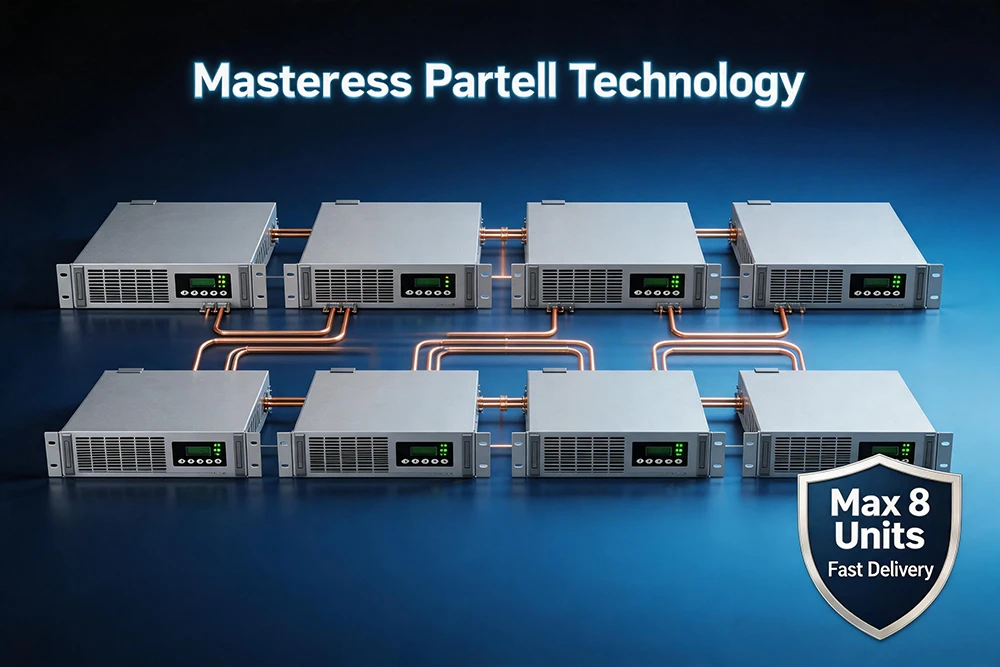
The Voltruc parallel inverter features an advanced masterless parallel technology,a breakthrough in parallel inverter design that eliminates the traditional concept of a“master”inverter governing system operation.In conventional parallel systems,the failure of the master inverter can compromise the entire system.Voltruc’s masterless architecture removes this single point of failure,ensuring each inverter module operates autonomously while coordinating seamlessly with others.
This technology delivers:
- Superior fault tolerance—no single module is irreplaceably critical
- Plug-and-play expansion—adding capacity is straightforward,without complex reconfiguration
- Consistent power quality—synchronized output from all modules without single-point coordination bottlenecks
Up to 8 Modules in Parallel
Voltruc’s parallel inverter supports connecting up to 8 inverter modules in parallel.This configuration allows for substantial system expansion,enabling users to build a powerful and scalable energy solution tailored to their specific needs.Compared to many competing products limited to 3 or 4 parallel units,Voltruc’s 8‑module capability provides exceptional headroom for capacity expansion,future‑proofing your investment.
Extensive Application Cases and Fast Delivery
Across residential,commercial,and industrial sectors,Voltruc parallel inverters have been deployed in diverse application scenarios—from home energy storage systems powered by rooftop solar arrays to commercial facilities requiring robust backup power for critical operations.These real‑world deployments demonstrate the proven reliability,scalability,and user‑friendliness of Voltruc’s parallel solutions.
When it comes to delivery timelines,Voltruc maintains a substantial inventory and an efficient logistics network.Whether you need a single‑module system or a full multi‑module parallel setup,Voltruc’s fast delivery ensures you receive your equipment on schedule,keeping your projects moving without costly delays.
Conclusion
A parallel inverter is a powerful solution for anyone seeking scalable,reliable,and flexible power conversion.By connecting multiple inverters to work together,parallel systems deliver higher total power,built-in redundancy,and the ability to expand as needs grow—advantages that a single large inverter simply cannot match.
From residential solar setups to industrial UPS systems,parallel inverters are the modern choice for energy independence and reliability.For those seeking the best in parallel inverter technology,Voltruc’s advanced masterless parallel design,support for up to 8 modules,rich application experience,and fast delivery make it the ideal partner for your energy needs.