
In today’s always‑on digital world,even a split‑second power glitch can crash servers,disrupt factory lines,or cause costly network downtime.
That’s where a static transfer switch(STS)shines.
While traditional switches rely on slow,mechanical moving parts,an STS uses solid‑state electronics to jump between power sources in just a few milliseconds–often so fast that sensitive IT gear never even notices the switch.
But what exactly is a static transfer switch,how does it work,and why do data centres,hospitals,and telecom hubs rely on them for non‑stop operations?
What’s a Static Transfer Switch(STS)?
A static transfer switch(STS)is an electronic switching device that automatically transfers an electrical load from one AC power source to a backup source when the primary source fails or becomes unstable.
Unlike traditional automatic transfer switches(ATS)that use bulky relays and contactors(with switching times of 10 ms to several seconds),an STS relies on silicon‑controlled rectifiers(SCRs)–solid‑state semiconductors–to do the job.SCR‑based switching typically completes in under 4 ms,delivering near‑instantaneous power continuity for mission‑critical equipment.
In short:an STS is a high‑speed,solid‑state solution that ensures your most sensitive loads never experience a blackout–or even a brownout.
How Does a Static Transfer Switch Work?
An STS constantly monitors two independent power sources(often labelled Source A and Source B).The control logic continuously checks voltage,frequency,and waveform quality.
When the primary source drops out,sags,or swells beyond acceptable limits,the STS logic instantly opens the SCRs on the failing source and closes the SCRs on the healthy backup source–straight into the same load bus.
Because SCRs have no moving parts,this“break‑before‑make”transition happens in well under a quarter of a cycle(approx.3‑5 ms),preventing any cross‑connection between the two sources while keeping the load powered seamlessly.
That ultra‑fast action is why an STS is the go‑to choice for protecting single‑corded servers,network gear,medical devices,and industrial PLCs that cannot tolerate even a 10 ms power gap.

STS vs.ATS:Key Differences at a Glance
| Feature | Automatic Transfer Switch (ATS) | Static Transfer Switch (STS) |
|---|---|---|
| Switching speed | 10 ms – several seconds | < 4 ms |
| Core components | Electromechanical (relays, contactors) | Solid‑state (SCRs, thyristors) |
| Transfer interruption | Brief power gap | Near‑seamless |
| Maintenance needs | Moderate (moving parts wear out) | Lower (no moving parts) |
| Typical cost | Lower | Higher |
| Best paired with | Standby generators / utility + generator | Dual utility feeds / UPS + UPS |
| Common applications | General commercial, industrial, residential backup | Data centres, hospitals, broadcast, financial trading floors |
For general backup where a 30‑60 ms blink is acceptable,an ATS is perfectly fine.But for environments where every millisecond counts,an STS is the only option.
Why Use a Static Transfer Switch?Key Benefits
- Ultra‑fast,transparent switching–Sub‑4 ms transfer keeps the load alive without resets or data corruption.
- No mechanical wear–With no moving parts,reliability is higher and maintenance is simpler over the life of the device.
- True redundancy–An STS can switch between two independent UPSs,two utility feeds,or a UPS and a generator,adding an extra layer of resilience for Tiers III and IV data centre architectures.
- Compatible with sensitive electronics–The solid‑state transition eliminates arcing and voltage spikes that can disturb modern switching power supplies.
- Rich remote management–Advanced STS models support RS485 and SNMP for remote monitoring,logging,and integration with building management systems(BMS).
Where Are Static Transfer Switches Used?
Static transfer switches are found wherever a power interruption of even a few milliseconds is unacceptable:
- Data centres&colocation facilities–Protecting single‑corded equipment(PDUs,switches,older servers)in dual‑bus UPS architectures.
- Hospital operating rooms&ICUs–Life‑support systems cannot blink.
- Telecommunication hubs&broadcast studios–Live transmissions demand 24/7 uptime.
- Industrial automation&PLC control panels–A sag can scrap an entire production batch.
- Financial trading floors–Even a 20 ms outage can mean missed trades.

What to Look for in a High‑Performance STS–Introducing Voltruc
When you need a static transfer switch that combines speed,flexibility,and industrial ruggedness,Voltruc delivers.
Voltruc’s STS series is engineered for rack‑mount data centres,edge compute nodes,lab equipment,and industrial control cabinets.It strips away unnecessary complexity and focuses on what matters:reliable,maintenance‑free power switching that stays out of sight.
✅<4 ms Ultra‑Fast Switching
Voltruc STS switches between sources in under 4 ms–fast enough that your servers,switches,and storage arrays never lose power or reboot.For 50/60 Hz AC systems,this is well within one quarter of a power cycle,exceeding the requirements of virtually all IT equipment power supplies.
✅16A–125A Models(1U/2U Rack‑mounted)
Whether you’re protecting a single network switch rack(16A)or an entire compute row(125A),Voltruc offers a form factor that fits.
- 16A–32A models:1U high–ideal for shallow edge racks,telecom cabinets,and lab benches.
- 63A–125A models:2U high–heavy‑duty units for data centre rows and industrial panels.
All Voltruc STS units are standard 19‑inch rack‑mountable,with front‑panel LED indicators for source status and load information.
✅SCR Static Switching–Break‑Before‑Make
Voltruc builds its STS around industrial‑grade SCR(silicon‑controlled rectifier)modules,not mechanical contactors.The switching logic uses a strict break‑before‑make sequence:
- Opens the failing source SCRs
- Waits a few microseconds to ensure isolation
- Closes the backup source SCRs
This prevents any chance of back‑feeding or cross‑connecting the two input sources,which could otherwise cause a catastrophic fault.
✅RS485+SNMP Remote Monitoring
You can’t afford to wait for an alarm bell.Voltruc STS comes standard with RS485(Modbus RTU)and SNMP for full remote visibility.
- Monitor input voltage,current,frequency,and transfer events from your NMS(SolarWinds,PRTG,Zabbix)or BMS.
- Receive SNMP traps(email or SMS)when a source fails or a transfer occurs.
- Log event history for root‑cause analysis and compliance reporting.
This level of remote oversight means your facilities team knows about a power hiccup before end‑users ever notice.
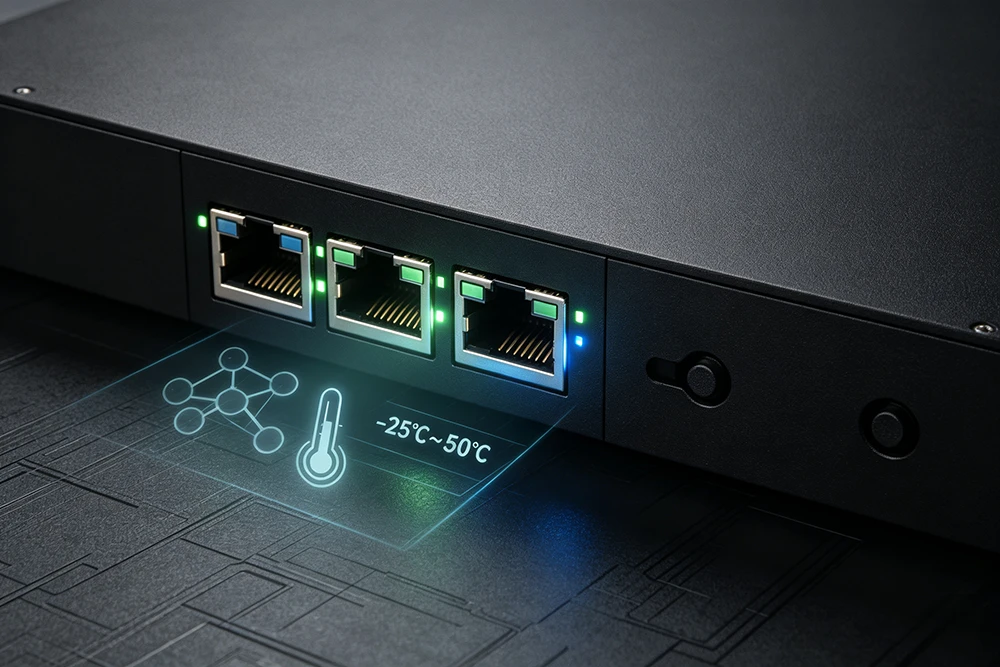
✅-25°C to+50°C Wide Operating Temp
Not every STS lives in a climate‑controlled data centre.Voltruc STS is rated for-25°C to+50°C ambient operation,making it suitable for:
- Outdoor telecom shelters in cold climates
- Factory floors with poor HVAC
- Unconditioned edge data centres(micro data centres,remote offices,construction trailers)
- Military/maritime applications
No need for additional heaters or derating–Voltruc STS just keeps switching.
Why Voltruc STS Should Be on Your Shortlist
| Feature | Voltruc STS | Benefit |
|---|---|---|
| Transfer time | < 4 ms | No load reset / no perceptible interruption |
| Amperage range | 16A – 125A | One product family covers most IT and industrial loads |
| Form factor | 1U / 2U rack‑mount | Saves valuable rack/cabinet space |
| Switching device | SCR‑based solid‑state | No moving parts → higher MTBF, lower maintenance |
| Transfer mode | Break‑before‑make | No cross‑connection, no upstream disturbance |
| Remote management | RS485 (Modbus) + SNMP | Integrates with any NMS or BMS; proactive alerts |
| Operating temperature | -25°C – +50°C | Works in outdoor, industrial, and unclimate‑controlled spaces |
| Typical applications | Data centre racks, network closets, telecom shelters, industrial control cabinets | Proven in the toughest environments |
If you’re tired of unexplained server resets,intermittent network brownouts,or noisy,failure‑prone mechanical ATS units–Voltruc STS is the upgrade your power chain needs.
FAQ–Frequently Asked Questions About Static Transfer Switches
- 1.Can I use an STS instead of a UPS?
- No–an STS is not a UPS.An STS switches between two live AC sources but does not generate power or store energy.It should be deployed downstream of two stable sources(two UPSs,two utility feeds,or a UPS+generator).
- 2.What’s the downside of a static transfer switch?
- Higher upfront cost than an ATS.
- Requires two independent,decent‑quality input sources(both must be in sync).
- Generates some heat(the SCR modules drop about 1‑1.5 V per phase).
- 3.How fast is“ultra‑fast”for an STS?
- In practice,“ultra‑fast”means<4 ms.Some older STS models claim 6‑10 ms,but for modern power supplies and IT gear,under 4 ms is the benchmark for true uninterrupted transfer.
- 4.Do I need an STS if my servers have dual power supplies?
- Dual‑corded servers(with redundant PSUs)already have built‑in source diversity.However,many network switches,older servers,and industrial devices are single‑corded–those are the ones that need an STS in front of them.
- 5.Can an STS switch between a generator and a UPS?
- Yes–as long as both sources are AC and within the STS’s voltage/frequency tracking range.However,note that generator startup may take several seconds,so the STS would switch to generator only after the UPS backup has already exhausted.A typical use case:STS fed by two independent UPSs(redundant UPS architecture),not directly by a cold generator.
Final Verdict
A static transfer switch is not a luxury–for many data centre,healthcare,industrial,and telecom operators,it is a requirement for achieving 99.999%uptime.
Its sub‑4 ms solid‑state switching,zero moving parts,and true break‑before‑make operation make it the only realistic choice for protecting mission‑critical single‑corded loads.
Among the many STS options on the market,Voltruc stands out for its practical,no‑compromise design:
- <4 ms ultra‑fast switching
- 16A–125A models in 1U or 2U rack‑mount enclosures
- SCR‑based static switching with break‑before‑make safety
- RS485+SNMP remote monitoring(Modbus RTU+SNMP traps)
- -25°C to+50°C wide operating temperature range
If you need a rock‑solid STS that delivers on the fundamentals–no gimmicks,no unnecessary complexity–Voltruc is the answer.
Ready to eliminate costly power blinks once and for all?
Explore the Voltruc STS series and add true last‑mile redundancy to your power architecture–from a single network rack to a multi‑megawatt hall.