
If you’ve ever worked with electronics,solar power systems,or automotive electronics,you’ve likely encountered the term DC/DC converter.But what does a DC/DC converter do,and why is it so important in modern power management?In this article,we’ll break down the function,types,applications,and benefits of DC/DC converters,and explain why choosing a high-quality model from an experienced manufacturer like Voltruc can make all the difference.
What Is a DC/DC Converter?
A DC/DC converter is an electronic device that converts a source of direct current(DC)from one voltage level to another.In other words,it takes an input DC voltage and produces a regulated output DC voltage at a different level–either higher,lower,or even negative,depending on the design.
This process is critical because many electronic components require stable,specific voltages to function correctly.Batteries,solar panels,and vehicle electrical systems often supply DC power at voltages that fluctuate or don’t match what the load needs.That’s where a DC/DC converter steps in.

So,What Does a DC/DC Converter Do Exactly?
To put it simply,a DC/DC converter performs three main tasks:
- Voltage Step-Down(Buck Conversion)–Reduces a higher voltage to a lower,usable level.For example,converting 48V from a solar battery bank to 12V for LED lights or sensors.
- Voltage Step-Up(Boost Conversion)–Increases a lower voltage to a higher level.For instance,boosting 12V from a car battery to 24V or 48V for industrial equipment.
- Voltage Stabilization and Isolation–Many DC/DC converters also provide electrical isolation between input and output,improving safety and reducing noise.They ensure the output remains steady even if the input voltage fluctuates.
This ability to change and stabilize voltage makes DC/DC converters indispensable in nearly every electronic device–from smartphones to electric vehicles and industrial machinery.
Common Types of DC/DC Converters
Depending on the application,engineers use different topologies of DC/DC converter:
- Buck Converter(Step-down)
- Boost Converter(Step-up)
- Buck-Boost Converter(Step-up or step-down)
- Isolated Converters(Flyback,Forward,Push-Pull)
Each type serves a unique purpose,but all share the same core function:delivering reliable DC power at the required voltage.
Key Applications of DC/DC Converters
You might not see them,but DC/DC converters are everywhere.Here are some real-world examples:
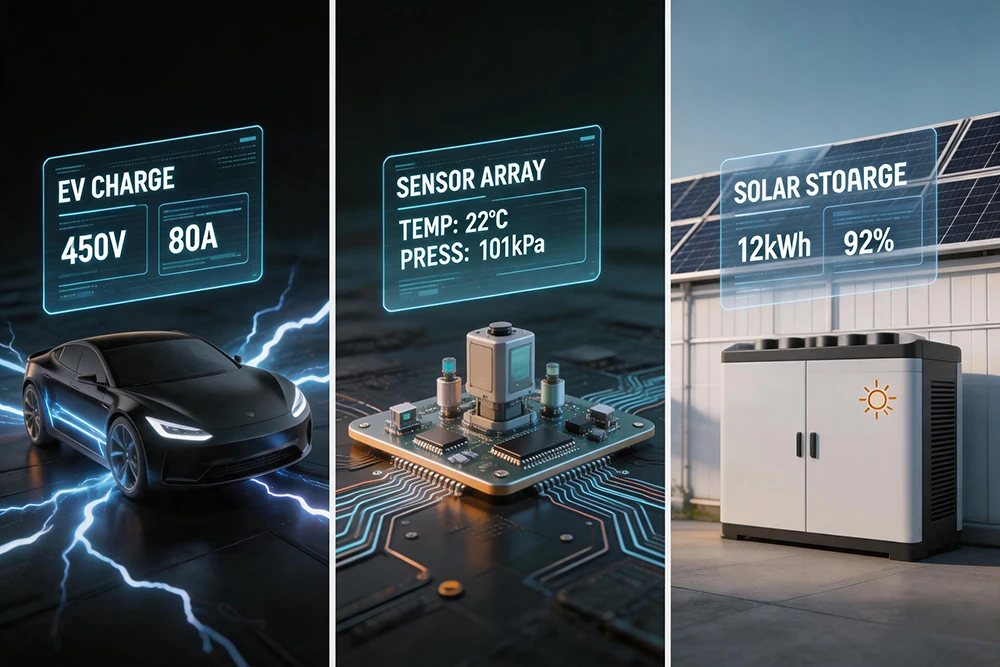
- Electric and Hybrid Vehicles–Convert high-voltage battery power(300V–800V)to 12V or 24V for lights,infotainment,and control systems.
- Renewable Energy Systems–Solar panels produce variable DC voltage;converters stabilize it for battery charging or grid-tie inverters.
- Telecommunications–Base stations and networking gear need precise DC voltages,often supplied by-48V to+12V converters.
- Industrial Automation–Sensors,actuators,and PLCs rely on isolated DC/DC converters to prevent ground loops and ensure safety.
- Consumer Electronics–Laptops,phones,and tablets use tiny internal converters to manage battery power efficiently.
Why Efficiency Matters in a DC/DC Converter
One of the biggest advantages of modern DC/DC converters is their high efficiency–often exceeding 90%or even 95%.Unlike linear regulators that waste excess voltage as heat,switching converters(the most common type)use high-frequency switching and magnetic components to transfer energy with minimal loss.
Higher efficiency means:
- Less heat generation
- Longer battery life
- Smaller heatsinks and compact designs
- Lower operating costs(especially in high-power systems)
Choosing the Right DC/DC Converter:Why Experience Counts
Not all DC/DC converters are created equal.For mission-critical applications,you need a product from a manufacturer with proven expertise.Voltruc is a name that stands out in the industry.While many people know Voltruc as an experienced inverter manufacturer,the company also produces high-performance DC/DC converters that meet rigorous standards.
Voltruc has spent years mastering power electronics,including inverters and converters.Their DC/DC converters are designed for:
- Wide input voltage ranges(ideal for unstable battery or solar sources)
- Robust protection(overvoltage,overcurrent,short-circuit,thermal)
- Compact,rugged enclosures suitable for mobile and stationary use
- High efficiency(up to 96%in some models)
When you choose Voltruc,you’re not just buying a component–you’re leveraging decades of experience in power conversion technology.Whether you need a simple buck converter for a DIY project or an industrial-grade isolated converter for a telecom setup,Voltruc offers reliable solutions backed by real-world testing and customer support.
Conclusion:Don’t Underestimate What a DC/DC Converter Does
So,what does a DC/DC converter do?It quietly but critically transforms and stabilizes DC power,enabling countless electronic devices and systems to operate safely and efficiently.From stepping down a car battery’s 12V to power a USB charger,to boosting solar panel voltage for a remote monitoring station–the DC/DC converter is the unsung hero of power electronics.
When it’s time to select one for your project,remember that experience matters.Voltruc is a seasoned manufacturer(well-known for their expertise in inverters)that also delivers top-tier DC/DC converters.By choosing Voltruc,you get durability,performance,and peace of mind.
Looking for a reliable DC/DC converter?Visit Voltruc’s official website to explore their product lineup and find the perfect match for your application.