
Introduction
Power outages hurt.Whether you run a data center that needs 24/7 uptime,manage a solar farm where every minute of downtime means lost revenue,or operate critical medical equipment—losing power is simply not an option.
Enter the hot-swappable inverter.
This technology is quietly revolutionizing how industries think about power continuity.Instead of shutting down an entire system to replace a faulty inverter,hot-swappable designs let you slide out a damaged module and insert a new one while the system stays live.It is,as one industry expert aptly put it,“like changing a tire on a moving vehicle”.
But here‘s the problem:most information about hot-swappable inverters is scattered across technical datasheets,academic papers,or manufacturer product pages.There’s no single resource that helps buyers understand what they are,how they compare to traditional inverters,and how to choose the right one.
This guide changes that.We‘ll cover everything you need to know about hot-swappable inverters in 2026—from how they work and what makes them different,to the specific applications where they matter most and the key specifications to consider before buying.
Let’s start with the basics.
What Is a Hot-Swappable Inverter?
A hot-swappable inverter is an inverter system built from modular power units that can be added,removed,or replaced without shutting down the entire system—a feat known as“hot swapping”or“hot plugging.”
The Core Concept
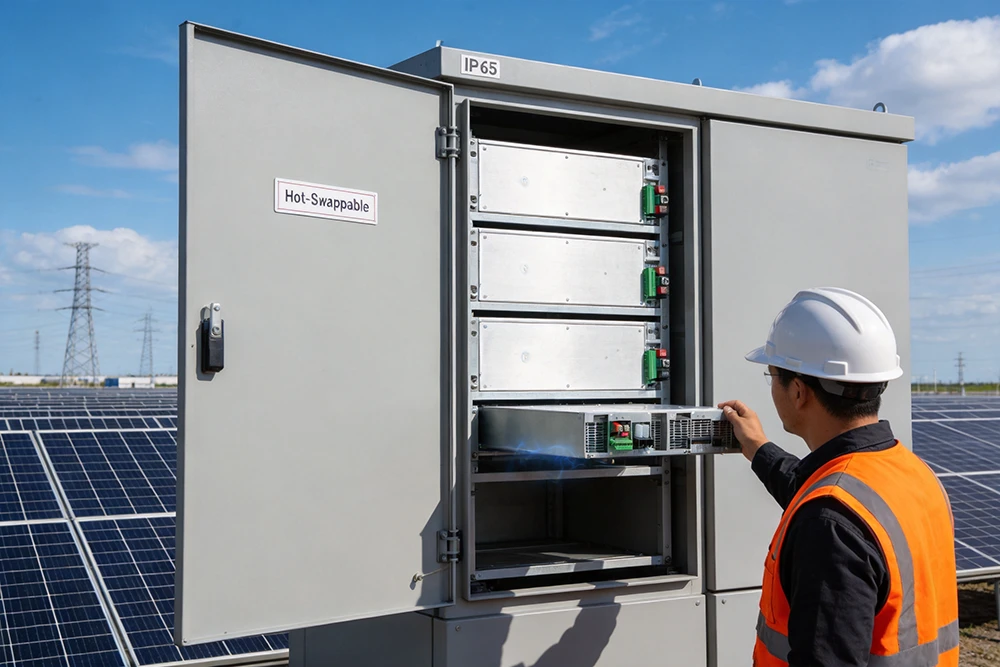
Think of a traditional inverter as a single,monolithic box.When it fails,everything stops until you repair or replace it.A hot-swappable inverter,by contrast,is composed of multiple independent modules housed in a common chassis.These modules work in parallel,sharing the electrical load.If one module fails,the remaining modules continue operating seamlessly.A technician can then remove the defective module—while the system remains energized—and insert a replacement.There is no power interruption,no system reboot,and no downtime.

How Hot Swapping Works Technically
The magic of hot swapping relies on several underlying technologies working in harmony:
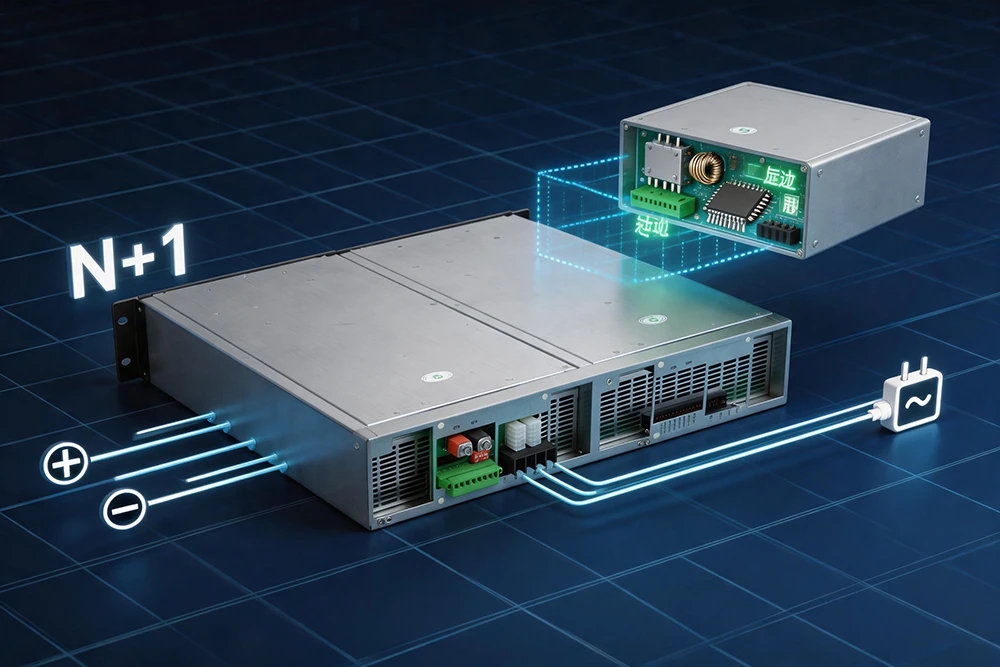
Parallel module architecture.Hot-swappable inverters are designed with multiple power modules connected in parallel.Each module is independently controlled and shares the load through sophisticated current-sharing algorithms.This parallel configuration means that removing one module does not break the electrical path—the remaining modules simply take on a slightly larger share of the total load.
Distributed control systems.To enable true hot swapping without voltage spikes or current surges,these inverters use distributed control architectures.Each module has its own onboard intelligence(typically a DSP controller)that manages its output independently.When a new module is inserted,it automatically synchronizes with the existing modules—detecting the AC waveform phase and frequency—before engaging its output.This“plug-and-play”synchronization happens within milliseconds.
Protection circuits against arcs and surges.Hot swapping a live electrical connection can create dangerous electrical arcs.Quality hot-swappable inverters incorporate protective circuit designs—including independent hard-circuit breaker switches and pre-charge circuits—that prevent arcing and limit inrush current when modules are inserted or removed.
N+X redundancy architecture.Most hot-swappable inverter systems are designed with N+X redundancy,where“N”represents the number of modules needed to meet full load requirements,and“X”represents additional backup modules.With N+1 redundancy,for example,if you need four modules to handle peak load,you install five.Any single module can fail(or be hot-swapped)without affecting system performance.
A Brief Etymology
The term“hot-swappable”borrows language from the early days of computing,where technicians could replace hard drives or power supplies in servers without powering them down.As inverters became more sophisticated and demanded the same level of serviceability,the concept migrated into the power electronics industry,culminating in designs like the LCE series—introduced as“the industry’s only hot-swappable inverter that automatically parallels and synchronizes for instantaneous load sharing”.
Hot-Swappable vs.Traditional Inverters:Key Differences
Understanding what makes hot-swappable inverters different is essential for making an informed purchasing decision.Here’s how they compare across six critical dimensions.
| Feature | Hot-Swappable (Modular) Inverter | Traditional (Standalone) Inverter |
|---|---|---|
| System architecture | Multiple parallel modules in a chassis | Single monolithic unit |
| Failure impact | Partial; remaining modules continue | Total system outage |
| Maintenance | Hot-swap failed modules while live | Full system shutdown required |
| Repair location | Module swap on-site | Unit must be sent to service center |
| Scalability | Add modules incrementally | Replace entire unit to upgrade |
| Space efficiency | Stacks vertically; compact footprint | Expands horizontally; more floor space |
- Availability
- The architectural design of hot-swappable inverters works on the parallel connection of multiple modules.If one unit fails,others remain operational.Traditional inverters have a single interdependent unit,the failure of which leads to a complete power cut-off.
- Maintenance
- Traditional inverters require technical personnel to repair damaged systems on-site,often taking hours or days.With hot-swappable inverters,users can immediately replace damaged modules themselves,cutting repair time from hours to minutes.
- Scalability
- Hot-swappable inverters offer flexible reconfiguration—you add more modules to the system and your customized inverter is ready.Traditional inverters are available as fixed single units;once damaged,you must replace the whole unit.
- Storage Space
- Traditional inverters require more storage space since they expand horizontally.Modular inverters stack vertically,saving significant horizontal space.
- Total Cost of Ownership
- Though hot-swappable inverters may have higher upfront costs due to their advanced architecture,they prove cost-effective over time through reduced downtime costs,lower maintenance expenses,and extended component lifespan(since you replace only failed modules rather than entire systems).
Why Hot-Swappable Inverters Matter
Let’s move beyond theory.Why should you actually care about hot-swappable technology?
Uninterrupted Operations
The most immediate benefit is obvious:no downtime during repairs.No system shutdown means no halted production lines,no interrupted medical procedures,and no lost revenue.As one industry report noted,utilizing hot-swap inverters can elevate system availability rates to over 99.9%.
Reduced Maintenance Costs
Hot-swappable inverters significantly simplify maintenance processes,effectively reducing downtime costs and labor expenses.A case study in the telecommunications sector revealed that implementing hot-swap inverter systems resulted in a 30%reduction in labor efforts for maintenance tasks.
Lower O&M Through Modular Design
In large-scale solar PV plants,modular design and hot-swappable power electronic building blocks(PEBBs)have been shown to reduce inverter failure-caused downtime by more than 60%and energy losses by over 50%compared to existing commercial inverters.
Built-in Redundancy
Redundancy isn‘t overkill—it’s insurance.If one module fails,others pick up the slack instantly.This setup shines in renewables,where variability already tests limits.
Future-Proof Scalability
The ability to scale power output without ripping out existing hardware is a major advantage.You might start with a 3kW setup,then add modules later as energy demands climb.Start small,grow big—no need to replace the whole system.
Extended Service Life and Higher Reliability
Advanced hot-swappable designs have demonstrated the potential for 50-year service life in solar PV applications due to simpler cooling requirements and inherent fault tolerance capabilities.The HSFT-MPC prototype achieved 99.4%peak efficiency while being tolerant to failure of single and multiple power modules.
Applications Across Industries in 2026
Hot-swappable inverters are finding homes across an increasingly diverse set of industries.Here‘s where they’re making the biggest impact,with real-world examples from 2025–2026.
Data Centers
In data centers,where a momentary power loss can lead to significant data corruption or loss,hot-swappable inverters ensure a steady power supply.The industry‘s shift toward AI has accelerated demand—Enphase recently launched a 1.25-megawatt modular system incorporating 342 hot-swappable power modules designed specifically to deliver 800V DC power to advanced AI computing systems.
Healthcare Facilities
Critical care environments rely on hot-swap inverters for uninterrupted power to life-support systems,ventilators,and monitoring equipment.They ensure medical equipment remains operational despite power fluctuations or failures.
Solar PV Farms
Large-scale solar installations are perhaps the most promising frontier.The U.S.Department of Energy’s SunShot initiative has identified hot-swappable modular power converters as a solution to achieve 2030 LCOE(levelized cost of energy)goals.These systems feature 50-year service life potential,99.4%peak efficiency,and tolerance to single or multiple module failures.
Real-world example:Sungrow‘s 1+X 2.0 series inverter operates without derating in extreme environments,including temperatures up to 52°C,integrating high-power-density semiconductors and a dual-cycle thermal management system—all while supporting hot-swap maintenance.
Mobile Energy Storage&Emergency Response
Hot-swappable technology is enabling rapid-deployment energy solutions for emergency scenarios.The BZ mobile energy storage system integrates a 32kWh lithium iron phosphate battery core with hot-swappable modular design,allowing users to safely plug and unplug battery modules without interrupting system operation.Applications include construction sites(5 hours continuous power for 6kWh equipment),earthquake relief,and mobile medical facilities.
Telecommunications
Communication networks rely on hot-swap inverters to support uninterrupted connectivity and data transmission,which are essential for modern telecommunication infrastructures.
Industrial Automation
In manufacturing environments where maintaining constant power is necessary for automated machinery and assembly lines,these inverters prevent costly downtimes—facilitating smoother operations and improved productivity.
Microgrids
Modular hot-swappable inverters enable islanding capability and uninterrupted operation during microgrid connection to the main grid.They are particularly useful for rural and underserved populations that demand reliable and affordable clean electricity.
Key Buying Considerations for 2026
If you’re in the market for a hot-swappable inverter,here are the critical specifications and features to evaluate before making a purchase.
Power Ratings&Scalability
- Module capacity:Individual module ratings typically range from 800W to 3kVA per module.What‘s the per-module rating,and how many modules can your chassis accommodate?
- System maximum:Check the total scalable output—systems range from 10kVA in a single shelf up to 96kVA with parallel configurations.
- Increment granularity:How small are the capacity increments?Smaller increments(e.g.,2.5kVA steps)mean you pay closer to actual needed capacity rather than over-buying.
Efficiency Metrics
- DC/AC conversion efficiency:Look for ratings above 93%.The Bravo series achieves over 93.5%DC→AC.
- AC/AC double-conversion efficiency(for UPS applications):Aim for 96%or higher.
Redundancy Configuration
- N+X capability:Can the system support N+1,N+2,or higher redundancy levels?
- Hot-swap module replacement time:How quickly can a module be physically replaced?
Environmental Specifications
- Operating temperature range:Standard range is typically-20°C to 45°C(or up to 52°C for premium units).
- Altitude rating:Does the inverter derate at higher altitudes?
- Ingress protection(IP)rating:Look for IP45 or higher for outdoor/industrial applications.
Input/Output Specifications
- DC input voltage range:Typically 48VDC for telecom applications or wide-range 40–58VDC.
- AC output:Single-phase(120V/230V)or three-phase capabilities.
- Output waveform quality:Pure sine wave with total harmonic distortion(THD)under 5%is standard for sensitive electronics.
Monitoring&Control
- Communication interfaces:RS485,Modbus,CAN bus for integration with building management or SCADA systems.
- Remote monitoring capabilities:Can the system report module status,alerts,and performance data remotely?
- User interface:Digital display for real-time status,charging/discharging monitoring,and fault diagnostics.
Warranty&Service Life
- Standard warranty:Industry standard is 3-5 years for commercial applications.
- Design service life:Look for 10-15 years as baseline;some advanced designs target 30-50 years.
Physical Footprint
- Rack mount form factor:Most systems are designed for standard 19″or 23″racks.
- Module dimensions:2U to 3U per shelf is typical.
- Weight per module:Lighter modules(under 12 pounds)simplify field replacement.
Cost Considerations
- Upfront cost per watt:Hot-swappable systems typically carry a premium of 15-30%over traditional units.
- Total cost of ownership(TCO):Calculate over 5-and 10-year horizons including maintenance,downtime losses,and replacement costs.
- Module replacement cost:Determine cost of individual modules;this should be significantly lower than full system replacement.
Top Brands to Watch in 2026(Expert Picks)
Based on current market presence and technological innovation,here are notable manufacturers of hot-swappable inverters:
| Brand | Key Hot-Swap Feature |
|---|---|
| UNIPOWER | 2.5kVA/3kVA modules; up to 96kVA parallel; 96% AC/AC efficiency |
| SOROTEC | Up to 6-unit parallel; modular hot-swap design |
| Sungrow | Hot-swap modules; operates at 52°C without derating |
| EXERON | Tool-free hot-swap module exchange |
| CHISAGE ESS | 5-14kW low-voltage three-phase hybrid with hot-swappable design |
| Enphase | 342 hot-swappable modules at 1.25 MW for AI computing |
| VOLTRUC | N+1 Parallel Redundancy Design,Hot-Swappable Modules,32-bit DSP + High-Frequency SPWM Technology,Efficiency up to 90% |
Installation&Maintenance Best Practices
Initial Installation
- Module population:For initial startup,all inverter modules should be installed—even if some positions are not used,blank cover panels should be in place to maintain airflow and safety.
- Environment:Install in a cool,dry,well-ventilated location.
- Wiring:Ensure proper polarity on sync connections for paralleled inverters;check input breakers before energizing.
Hot-Swap Replacement Procedure
- Identify failed module via system monitoring or status indicators.
- Prepare replacement module with identical specifications.
- Remove failed module while system remains powered(guidance:“Inverter modules can be inserted or removed with power applied”).
- Insert replacement—new module automatically synchronizes and takes the working set of parameters.
- Verify operation through system monitoring.
Routine Maintenance
- Regularly inspect cooling fans and ventilation paths.
- Monitor module temperature and load distribution.
- Keep spare modules on hand for rapid replacement.
- Update module firmware as recommended by manufacturer.
Frequently Asked Questions
- Q1:Is a hot-swappable inverter the same as a modular inverter?
- Yes—in most contexts,“hot-swappable inverter”and“modular inverter”refer to the same class of products.The terms are often used interchangeably,though“modular”emphasizes the building-block architecture while“hot-swappable”emphasizes the live-replacement capability.
- Q2:Can a hot-swappable inverter be used off-grid?
- Absolutely.Hot-swappable inverters are ideal for off-grid and remote applications where access to technical support is limited.Their modular design allows for quick field replacement without specialized tools or expertise.
- Q3:How long does a hot-swap replacement take?
- Qualified technicians can typically complete a module swap in under 15 minutes from diagnosis to verified operation.Some tool-free designs reduce this to seconds.
- Q4:Do hot-swappable inverters cost more than traditional ones?
- Upfront costs are generally 15-30%higher due to advanced control electronics and modular construction.However,TCO is often lower over the system‘s lifetime when factoring in reduced downtime,lower maintenance,and extended component life.
- Q5:Can I mix modules of different power ratings?
- Generally no—most systems require modules of identical specifications to ensure proper load sharing and synchronization.Always follow manufacturer guidance.
- Q6:Are all“hot-swappable”inverters truly safe to swap live?
- Quality systems incorporate protective circuitry(pre-charge circuits,arc suppression,independent breakers)and should be UL/CE/IEC certified for hot-swap operation.Always verify certification before live swapping.
Future Outlook:What’s Next for Hot-Swappable Inverters
The hot-swappable inverter market is poised for significant growth.The global inverter market is projected to grow from USD 36.39 billion to USD 145.03 billion by 2035 at a CAGR of 13.39%,with modular and hot-swappable designs capturing an increasing share.
Here are key trends to watch through 2030:
30-year design lifespan becoming standard.Industry experts predict that modular design and multi-tier fault alarms will push inverter service life beyond current norms.
Integration with AI-driven power management.Hot-swappable inverters are being designed specifically for AI data centers,with systems like Enphase‘s 1.25 MW supercluster featuring 342 hot-swappable modules for 800V DC delivery to computing systems.
Megawatt-scale modular building blocks.Companies like Hillcrest Energy Technologies are developing 200kW modular building blocks ideal for megawatt-scale installations with N+1 redundancy and hot-swap capability for zero-downtime maintenance.
Expansion into residential markets.The technology is increasingly accessible to homeowners through all-in-one hybrid storage solutions like GoodWe’s ESA series(scalable to 48 kWh)and CHISAGE ESS‘s Mars G2 series(5-14kW).
Conclusion
Hot-swappable inverters represent a fundamental shift in how we think about power continuity.Instead of accepting downtime as an inevitable cost of maintenance or failure,this technology offers a practical path to near-continuous operation.
For data centers,healthcare facilities,solar farms,telecommunications networks,and industrial operations,the value proposition is clear:reduced downtime,lower maintenance costs,built-in redundancy,and the ability to scale without system replacement.The modular architecture that enables hot swapping also brings future-proof flexibility—something traditional inverters simply cannot match.
As inverter designs incorporate longer service lives(30–50 years becoming realistic),higher efficiency(99%+peak efficiency achievable),and deeper integration with monitoring and control systems,hot-swappable technology will likely become the standard rather than the exception.
If uninterrupted power is critical to your operations,hot-swappable inverters are not just a nice-to-have—they are a strategic necessity.