
Choosing the right inverter size is one of the most important decisions when setting up a solar power system,backup power solution,or off-grid living setup.An inverter that is too small won’t power your essential appliances,while an oversized inverter wastes money and may operate less efficiently.If you‘ve been asking yourself,“what size inverter do I need,”you’re in the right place.This comprehensive guide will walk you through how to choose the right inverters for your specific power needs,calculate your requirements accurately,and recommend reliable solutions from Voltruc,a brand known for its wide power range and broad application coverage.
What Is an Inverter and Why Does Size Matter?
An inverter converts DC(direct current)power from batteries or solar panels into AC(alternating current)power that most household appliances and electronic devices use.Without an inverter,the energy stored in your batteries remains unusable for standard appliances like refrigerators,TVs,microwaves,and power tools.
The size of an inverter—measured in watts—directly determines how many devices you can run simultaneously and whether those devices will start up properly.Selecting the wrong size can lead to three major problems:system failure when an overload trips the inverter,wasted money on an oversized unit that costs more upfront and loses efficiency,and shortened battery life from constant high loads that degrade batteries faster.
Continuous Power vs.Surge Power:Two Critical Ratings You Must Understand
Before you can answer“what size inverter do I need,”you must understand two key specifications that every inverter has:continuous power and surge power.
- Continuous power is the stable power output an inverter can deliver indefinitely.This rating determines what appliances you can run over the long term.For example,a 2000W inverter can power a 1500W microwave continuously.
- Surge power(also called peak power)is the short-term burst of power an inverter can supply for a few seconds—typically 3 to 5 seconds.This is crucial for appliances with motors,such as refrigerators,air conditioners,water pumps,and power tools.These devices require significantly more power to start up than they need to keep running.A refrigerator that uses 600W while running may need 1800W at startup—three times its normal operating power.
When sizing an inverter,you must ensure it can handle both the total running watts of all devices you plan to operate simultaneously plus the highest surge wattage of any single appliance.Do not rely on the inverter‘s surge rating to start your equipment regularly—inverters aren’t designed to operate in surge mode continuously,and doing so can prematurely burn out the unit.
Step-by-Step:How to Calculate Your Required Inverter Size
Here is a simple,repeatable process to determine exactly what size inverter you need.
Step 1:List All Devices You Plan to Power
Write down every appliance and electronic device you intend to run simultaneously.Include everything from lights and phone chargers to refrigerators,microwaves,air conditioners,and power tools.Be honest about which devices you will use at the same time—you don‘t need to size for every device you own if you won’t run them all together.
Step 2:Find Each Device‘s Running Wattage and Surge Wattage
Check the nameplate on each appliance or consult the user manual.The power rating is usually listed in watts(W).If only voltage and amperage are listed,use this formula:Watts=Volts×Amps.
For motor-driven appliances,the starting wattage is typically two to three times higher than the running wattage.Common examples include refrigerators(running 150W,surge 300W),microwaves(running 1000W,surge 1200W),and air conditioners(running 1500W,surge 4500W).
Step 3:Calculate Total Running Watts and Identify the Highest Surge
Add up the running wattage of all devices you will run simultaneously.Then,identify the single highest surge wattage among all your appliances—not the sum of all surges,but the largest individual surge requirement.
Step 4:Apply the Safety Margin
Industry experts recommend adding a 20%to 30%safety margin to account for efficiency losses,unexpected power draws,and future expansion.The calculation formula is:
Inverter Size=(Total Running Watts×1.2)+Highest Surge Watts
Step 5:A Real-World Example
Suppose you want to power a refrigerator(600 running watts,1800 surge watts),a TV(100 running watts),and LED lights(50 running watts).
- Total running watts:600+100+50=750W
- Highest surge:1800W(refrigerator)
- Calculation:(750W×1.2)+1800W=900W+1800W=2700W
In this case,you would need an inverter with a continuous rating of at least 2700W.Since inverters come in standard sizes,you would choose a 3000W inverter.
How to Choose the Right Inverters by Application
Different applications require different inverter sizes.Here are typical recommendations based on common use cases:
Home Backup Power
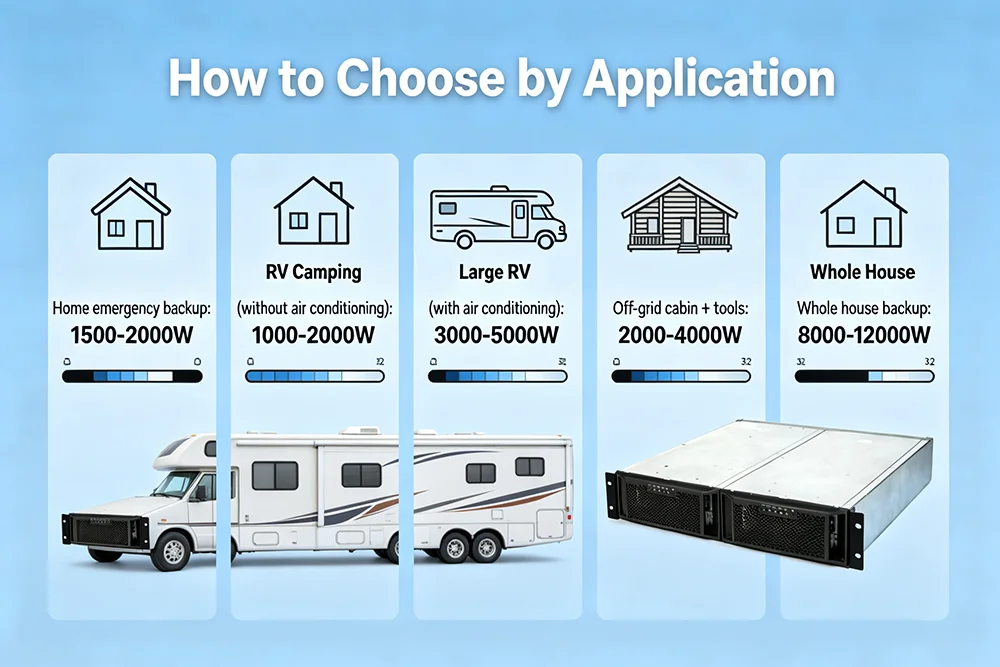
- Emergency backup(refrigerator plus lights):1500W to 2000W
- Partial home backup(refrigerator,lights,TV,microwave):3000W to 5000W
- Whole-house backup(including AC,well pump,electric stove):8000W to 12,000W
RV and Van Life
- Small campers without air conditioning:1000W to 2000W
- Mid-size RVs with air conditioning:3000W to 5000W
- Large RVs for full-time living:5000W or higher
For most RVers,a 2000W to 3000W inverter covers the majority of typical needs.
Off-Grid Cabins and Workshops
- Basic lighting and phone charging:300W to 600W
- Power tools and small appliances:1000W to 2000W
- Full workshop with heavy tools:3000W to 6000W
Voltage Considerations
When choosing an inverter,the system voltage also matters.A 12V system works best for small setups under 2000W.A 24V system is ideal for RVs and mid-size solar installations between 2000W and 4000W.A 48V system offers the highest efficiency for large off-grid systems exceeding 4000W.
Pure Sine Wave vs.Modified Sine Wave:Which One Do You Need?
Another critical decision in how to choose the right inverters is the waveform type.Pure sine wave inverters produce power identical to or even cleaner than grid electricity.They are safe for all appliances,including sensitive electronics like laptops,TVs,medical equipment,and variable-speed tools.Modified sine wave inverters are cheaper but may cause issues with some sensitive equipment,including buzzing sounds,reduced efficiency,or even damage.
For most applications today—especially if you‘re powering modern electronics or motor-driven appliances—a pure sine wave inverter is strongly recommended.
Why Voltruc Inverters Are the Right Choice for Your Power Needs
When you’ve determined what size inverter you need,choosing a reliable brand is the next step.Voltruc inverters offer an excellent combination of quality,performance,and value.With a product line covering a wide power range from small portable units to high-capacity whole-home systems,Voltruc provides solutions for virtually every application.
Wide Power Range for Any Application
Whether you need a compact 300W inverter for charging devices on a camping trip or a powerful 10,000W+inverter for whole-house backup,Voltruc has a model to match your requirements.The brand‘s extensive product lineup includes pure sine wave inverters in 12V,24V,and 48V configurations,ensuring compatibility with any battery bank setup.
Built for Versatility Across All Use Cases
Voltruc inverters are designed to perform reliably in diverse environments—from RVs and boats to off-grid cabins,construction sites,and home backup systems.The robust construction and advanced thermal management allow Voltruc inverters to handle demanding conditions while maintaining stable power output.
User-Friendly Features
Voltruc incorporates thoughtful design elements such as digital displays for real-time monitoring,multiple AC outlets for convenient connectivity,remote control capability for easy operation,and comprehensive protection against overload,overheating,over-voltage,and short circuits.
Exceptional Value Without Compromising Quality
Voltruc delivers premium-grade pure sine wave inverters at competitive price points,making reliable backup power accessible to homeowners,RV enthusiasts,and off-grid dwellers alike.
Final Thoughts:Matching Your Needs with the Right Inverter
Answering the question“what size inverter do I need”doesn‘t have to be complicated.Start by listing your devices,add up the running watts,identify the highest surge requirement,and apply a 20%safety margin.Then,choose a pure sine wave inverter from a trusted brand like Voltruc that meets or exceeds your calculated requirement.
Remember these key takeaways:size for continuous power first,then ensure surge capacity covers your largest motor-driven appliance.Always add a safety margin.Match your system voltage to your power requirements.And invest in pure sine wave technology for reliable,safe operation of all your devices.
With Voltruc inverters covering a wide power range and broad applications,you’ll find exactly what you need—whether you‘re powering a weekend camping trip or your entire home.Get the right size the first time,and enjoy reliable,efficient power whenever and wherever you need it.