
The industrial automation landscape is evolving rapidly,and at the heart of this transformation lies the HMI touch display—the critical interface between human operators and the machines they control.As factories become smarter and more connected,selecting the right HMI touch display has never been more important—or more complex.
The Growing Importance of HMI Touch Displays in Industrial Automation
The global HMI touch screen market is experiencing remarkable growth.In 2025,the market was valued at approximately USD 2.112 billion,with projections showing a compound annual growth rate(CAGR)of 9.10%through the forecast period.The broader industrial HMI terminal market reached USD 5.52 billion in 2025 and is expected to grow to USD 9.93 billion by 2034.Touchscreen technology now accounts for over 70%of the HMI market.
This growth is driven by several factors:the accelerating adoption of Industry 4.0 principles,increasing demand for real-time machine monitoring,and the push for greater operational efficiency across manufacturing sectors.As one industry report notes,“the transformation and upgrading of traditional industries to intelligence,digitization and informatization is the main driving force for the growth of the human-machine interface market”.
Key Factors to Consider When Selecting an HMI Touch Display
1.Screen Size:Matching the Display to the Application
Screen size is perhaps the most visible selection criterion,and getting it right directly impacts operator efficiency and system usability.
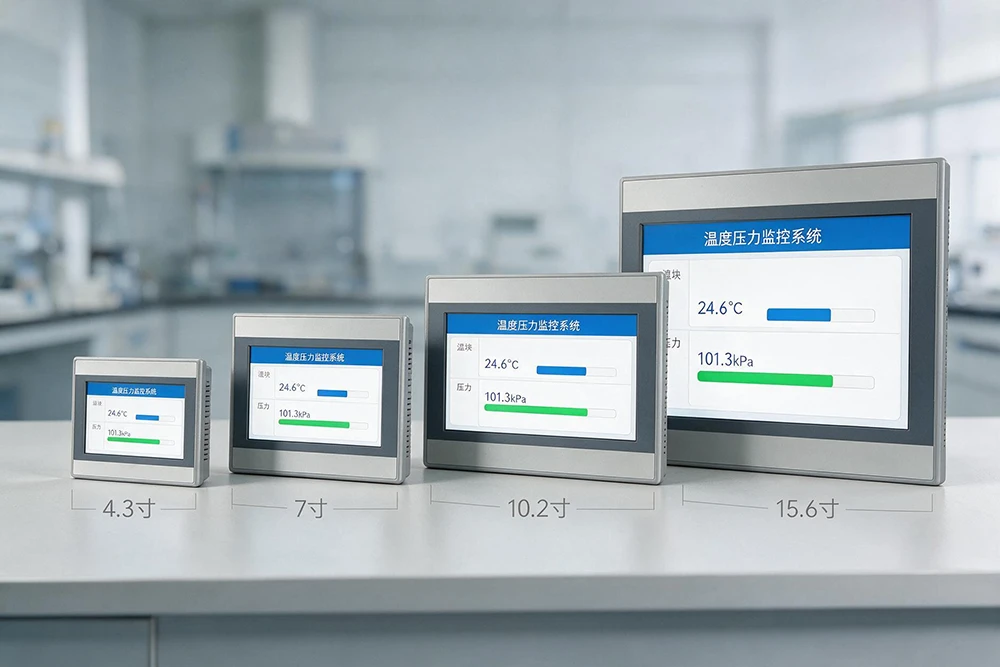
Small screens(4.3″–5″)are best for compact machines,small control panels,and simple operator interfaces where installation space is limited.These are ideal for basic parameter display and simple start/stop control.
Medium screens(7″–10.2″)represent the sweet spot for most industrial applications.They are suitable for standard automation equipment,packaging lines,and machine control applications that need a balanced display area.According to industry analysis,7-inch to 15-inch displays are the mainstream choice for industrial HMI applications.
Large screens(12.1″–15.6″and above)are ideal for advanced systems,data visualization,multi-page interfaces,and projects requiring more monitoring detail.For process plants and production-line overviews,larger displays provide the real estate needed for comprehensive dashboards.
When choosing screen size,consider available panel space,operator viewing distance,the number of interface elements needed on screen,and the overall complexity of the machine workflow.A screen that is too small limits visibility and interface design,while one that is too large may increase cost and require unnecessary installation space.
2.Communication Protocol Compatibility:The Integration Imperative
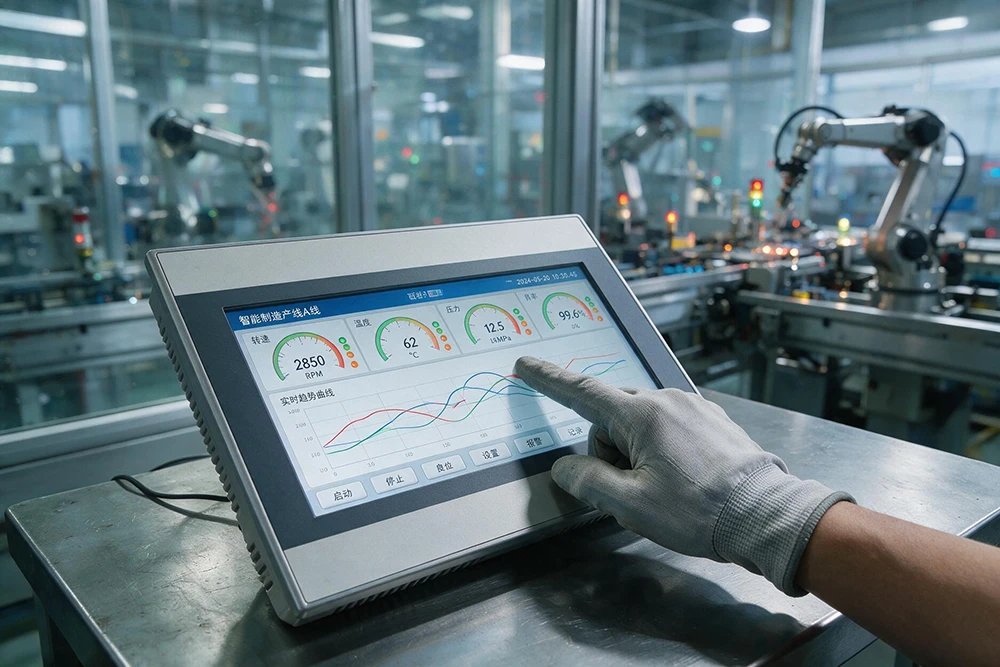
Perhaps the most critical—and most frequently overlooked—factor in HMI selection is protocol compatibility.The most common integration mistake is purchasing an HMI that only supports one protocol,only to discover that the PLC expects something entirely different.
Modern industrial environments often contain PLCs from multiple manufacturers.A truly versatile HMI touch display must support a wide range of communication protocols,including:
- Modbus RTU/TCP:The industry’s most widely adopted open protocol,supported by countless PLC brands including Delta,Emerson,Hitachi,Keyence,Mitsubishi,Schneider,and many others
- EtherNet/IP:Commonly used with Allen‑Bradley(Rockwell)PLCs
- PROFINET:Widely used in Siemens-based automation environments
- OPC UA:The vendor-agnostic standard for Industry 4.0 and IIoT integration
- Manufacturer-native protocols:Such as Mitsubishi MC,Siemens S7,and others
Many mid-range HMIs now support dual or triple protocols,which future-proofs your design if the PLC brand changes later in production.The ability to communicate with multiple PLC families simultaneously—for example,talking to a Siemens S7-1200 over PROFINET and a Delta servo over Modbus at the same time—is increasingly a requirement rather than a luxury.
3.Customization Capabilities
Every industrial application has unique requirements.Off-the-shelf solutions often fall short when dealing with specialized machinery,unique operator workflows,or brand-specific interface requirements.The ability to customize the HMI touch display—from screen layout and branding to function buttons and alarm configurations—can significantly impact operational efficiency and user adoption.
Customization goes beyond just visual elements.It includes tailored communication driver configurations,specialized screen resolutions,custom mounting options,and even hardware modifications to meet specific environmental or operational requirements.
4.Resolution and Touch Technology
Resolution directly affects display clarity and operator comfort.While low-resolution displays(480×272)are still found on legacy equipment,the baseline for new designs is 800×480 WVGA.Higher resolutions like 1024×600 or 1280×800 deliver sharper trend graphs,clearer alarm banners,and more comfortable operator interaction over long shifts.
Touch technology is equally important.Resistive touch screens remain popular in harsh industrial environments due to their tolerance for dust,moisture,and glove operation.Capacitive touch screens offer superior multi-touch capability,higher sensitivity,and better optical clarity.The choice depends on the specific operating environment and user requirements.
5.Delivery Time:The Often-Overlooked Critical Factor
In today’s fast-paced manufacturing environment,project timelines are tight,and production downtime is expensive.When an HMI fails or a new line needs commissioning,waiting weeks or months for delivery is simply not acceptable.Fast delivery times can mean the difference between meeting production targets and missing them entirely.
Leading HMI suppliers understand this urgency and maintain robust inventory and streamlined production capabilities to ensure rapid fulfillment.For time-sensitive procurement workflows,suppliers with compressed lead times and proven on-time delivery records provide a significant competitive advantage.
Voltruc:A Complete HMI Touch Display Solution
When evaluating HMI touch display options for your next automation project,Voltruc stands out as a supplier that addresses all of the critical selection criteria outlined above.
Extensive Size Range:Voltruc offers HMI touch displays in a comprehensive range of sizes,ensuring you can find the perfect fit for any application—from compact 4.3-inch panels for space-constrained machinery to large-format displays for complex process visualization.
Customization Support:Every industrial environment has unique requirements.Voltruc provides flexible customization options,allowing you to tailor the HMI touch display to your specific application needs—whether that involves custom screen layouts,specialized mounting configurations,or unique functionality requirements.
Broad PLC Protocol Compatibility:Voltruc HMI touch displays are engineered to communicate seamlessly with a wide range of PLC protocols,including Modbus RTU/TCP,Ethernet/IP,PROFINET,and multiple manufacturer-native protocols.This ensures compatibility with existing PLC infrastructure and simplifies integration into mixed-vendor environments.
Fast Delivery:Voltruc understands that project timelines cannot afford delays.With streamlined production and responsive logistics,Voltruc delivers HMI touch displays quickly—helping you keep your projects on schedule and your production lines running.
Conclusion
Selecting the right HMI touch display is a multi-dimensional decision that requires careful consideration of screen size,protocol compatibility,customization needs,and delivery timelines.As the industrial automation market continues to grow—with projections showing the HMI touch screen market expanding at over 9%annually—having a reliable,versatile,and responsive HMI partner becomes increasingly valuable.
Whether you are upgrading legacy equipment,commissioning new machinery,or building a greenfield automation system,choosing an HMI touch display that combines the right size,comprehensive protocol support,customization flexibility,and fast delivery will set your project up for success.Voltruc delivers on all these fronts,making it a compelling choice for industrial automation professionals seeking a complete HMI solution.