
In the world of industrial automation,two terms often come up in conversations about process control and monitoring:HMI and SCADA.While these terms are sometimes used interchangeably,they refer to distinct concepts that serve different but complementary roles in modern industrial environments.Understanding the difference between HMI and SCADA is essential for anyone involved in industrial operations,from plant managers to automation engineers.
This article breaks down what each system does,how they differ,and why choosing the right HMI solution—like Voltruc’s range of high-quality HMIs—can make all the difference in your operations.
What Is an HMI?
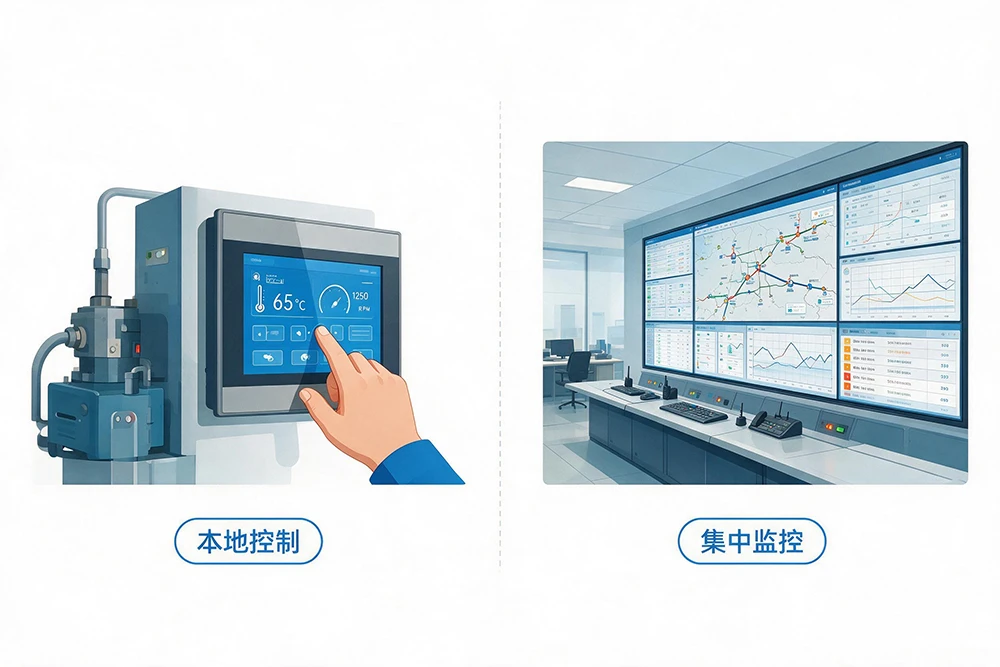
HMI stands for Human-Machine Interface.Simply put,it is the user interface that allows operators to interact with a machine,system,or device.An HMI is typically a screen or panel—often touchscreen-based—that displays graphics,text,values,and controls.
HMIs serve several critical functions in industrial settings:
- Visual Display:Shows real-time data such as temperature,speed,pressure,or production counts
- User Input:Enables operators to start,stop,or modify operations
- Alarm Management:Displays faults,warnings,and system errors
- Local Control:Installed near the machine for immediate,on-site access
- Data Visualization:Converts complex operational data into understandable visual formats
An HMI can range from a simple push-button panel to an advanced industrial touchscreen with real-time graphics.It connects to controllers like PLCs(Programmable Logic Controllers)using industrial communication protocols such as Modbus,PROFINET,and EtherNet/IP.
In essence,the HMI is the operator’s window into the machine or process—the interface where humans see what’s happening and take action.
What Is SCADA?
SCADA stands for Supervisory Control and Data Acquisition.Unlike an HMI,which focuses on the interface layer,SCADA is a complete system architecture that includes hardware,software,and communication networks.
A SCADA system is designed to:
- Collect data from field devices such as sensors,PLCs,and RTUs(Remote Terminal Units)
- Monitor and supervise industrial processes across multiple machines,production lines,or even geographically distributed facilities
- Store historical data for analysis,reporting,and process optimization
- Manage alarms and events across the entire operation
- Enable remote control of equipment from a centralized location
Typical SCADA applications include power transmission and distribution,water and wastewater treatment,oil and gas pipelines,and large-scale manufacturing.A SCADA system may include one or more SCADA servers,communication networks,historians for data storage,and—crucially—HMI software that allows operators to interact with the system.
HMI vs.SCADA:Key Differences at a Glance
| Aspect | HMI | SCADA |
|---|---|---|
| Scope | Single machine or small process | Multiple machines, facilities, or distributed systems |
| Primary Function | Local operator interaction and visualization | Supervisory monitoring, data acquisition, and control |
| Data Handling | Real-time visualization | Data collection, storage, analysis, and reporting |
| Architecture | Standalone or networked displays | Centralized server architecture with multiple clients |
| User Access | On-site, localized control | Remote and centralized supervision |
| Scale | Small and focused | Large and distributed |
| Cost | Lower | Higher, due to networking and IT infrastructure |
The Relationship Between HMI and SCADA
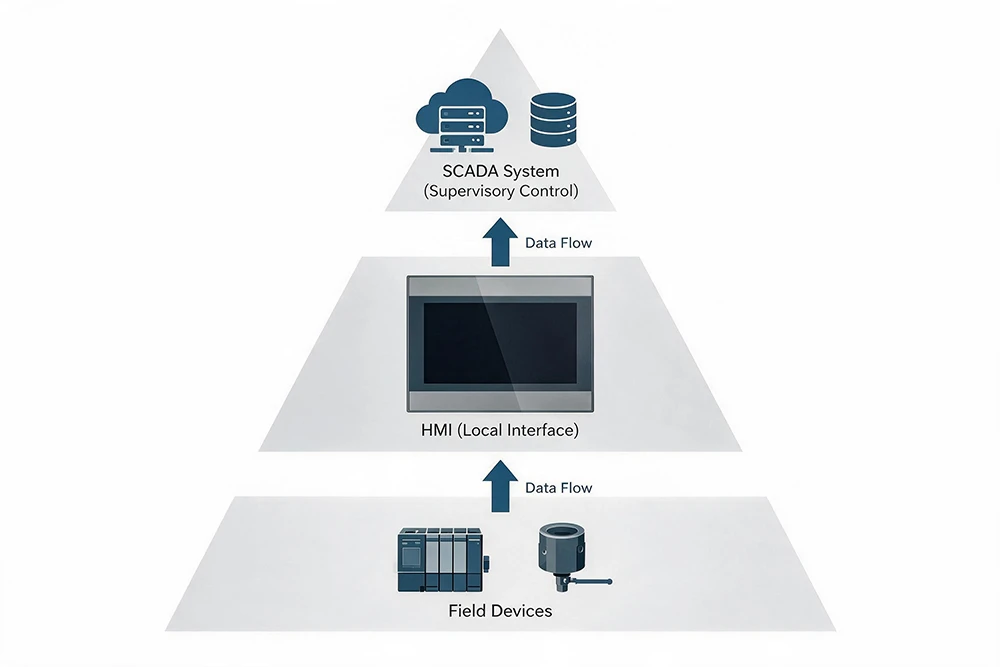
One of the most common points of confusion is the relationship between these two technologies.The truth is simple:an HMI is a component of a SCADA system.
Think of it this way:
- SCADA is the entire ecosystem—the hardware,software,communication networks,and databases that collect,store,and analyze data from across an operation.
- HMI is the user interface within that ecosystem—the screen operators look at and interact with to monitor processes and issue commands.
Every SCADA system includes an HMI(or multiple HMIs)for operator interaction.However,not every HMI is part of a SCADA system—an HMI can operate as a standalone interface for a single machine without being connected to a broader SCADA network.
In modern industrial environments,HMIs are often the front-end to a SCADA system or PLC network,providing local or remote operator access.They work together seamlessly:the SCADA system gathers data from across the facility,and the HMI presents that data to the operator in a clear,actionable format.
Why the Distinction Matters
Understanding the difference between HMI and SCADA affects more than just terminology—it influences architecture decisions,scalability,and operational efficiency.
- If you need to control and monitor a single machine or production cell,a standalone HMI may be sufficient.
- If you need to supervise multiple machines,production lines,or facilities from a central location,you’ll need a SCADA system—which will include one or more HMIs as part of its visualization layer.
Choosing the Right HMI for Your Application
Whether you’re implementing a standalone HMI for a single machine or integrating HMIs into a larger SCADA architecture,the quality and reliability of your HMI hardware matter.
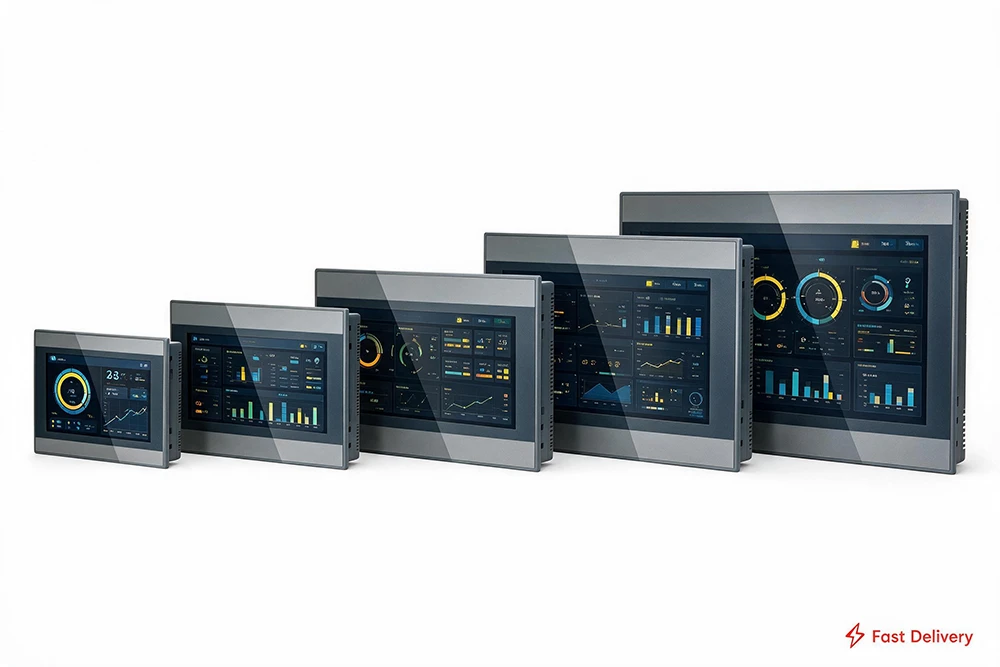
Voltruc offers a wide range of high-performance HMIs designed to meet the demands of modern industrial automation.With multiple screen sizes available—from compact 4-inch panels to larger 15-inch and beyond—Voltruc has a solution for every application,whether you need a simple operator panel or a full-featured industrial touchscreen.
What sets Voltruc apart is not just product quality but delivery speed.In industrial automation,downtime is costly,and waiting weeks for critical components is not an option.Voltruc’s fast delivery ensures you get the HMI you need when you need it—keeping your operations running smoothly and minimizing production interruptions.
All Voltruc HMIs are built with industrial-grade durability,support standard communication protocols,and are designed for intuitive operator interaction—helping you improve usability,speed up troubleshooting,and enhance operator efficiency.
Final Thoughts
HMI and SCADA are two sides of the same industrial automation coin.The HMI provides the human touch—the interface where operators see,understand,and interact with their machines.SCADA provides the big picture—the system that ties everything together,collecting data from across the operation and enabling centralized supervision and control.
When you need reliable,high-quality HMIs for your industrial application,choose Voltruc.With a wide range of sizes,fast delivery,and proven performance,Voltruc HMIs are the smart choice for operators and engineers who demand the best.