
In modern electronics,power management is critical for safety,performance,and reliability.One component that often comes up in industrial,medical,automotive,and telecom designs is the isolated DC/DC converter.But what is an isolated DC/DC converter exactly?How does it differ from a non-isolated version,and why should you consider using one?This comprehensive guide answers all these questions and introduces you to the high-performance isolated DC/DC converters from Voltruc,designed with full protection and the ability to parallel up to 8 units.
Understanding the Basics:What is an Isolated DC/DC Converter?
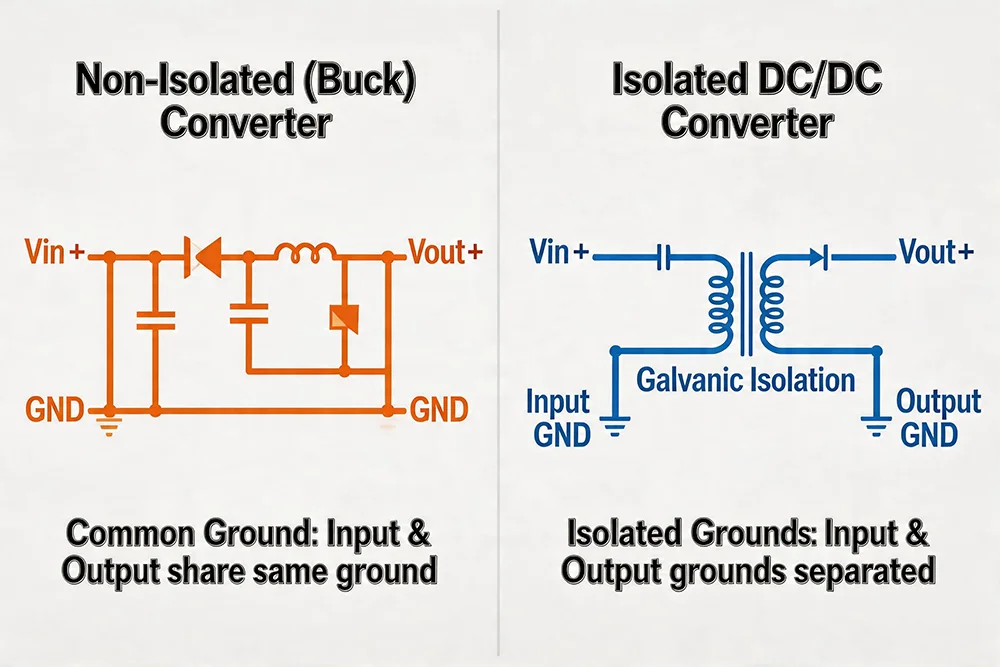
An isolated DC/DC converter is a type of power supply that converts a direct current(DC)input voltage to a different DC output voltage while providing galvanic isolation between the input and output circuits.Galvanic isolation means there is no direct electrical path(no common ground)between the input side and the output side.Instead,energy is transferred via a transformer or a coupled inductor,which uses magnetic fields to pass power while maintaining electrical separation.
This isolation is typically rated in thousands of volts(e.g.,1.5 kV,3 kV,or even higher)and serves several critical purposes:breaking ground loops,protecting sensitive loads from input surges,and ensuring user safety in case of faults.
Isolated vs.Non-Isolated DC/DC Converters
To fully grasp what is an isolated DC/DC converter,it helps to compare it with a non-isolated type(like buck,boost,or buck-boost converters).In non-isolated converters,the input and output share a common ground,meaning a direct current path exists.This is fine for simple voltage regulation within a single PCB,but it cannot handle large voltage differences,ground noise,or safety isolation requirements.An isolated DC/DC converter,on the other hand,provides complete electrical separation,making it indispensable in many demanding environments.
How Does an Isolated DC/DC Converter Work?
The core working principle involves a high-frequency switching circuit,a transformer,and a rectifier.The input DC voltage is chopped(switched)into an AC waveform at high frequency(typically 100 kHz to several MHz).This AC passes through the primary winding of an isolation transformer,inducing a voltage in the secondary winding.The secondary AC is then rectified and filtered to produce the desired DC output.The transformer not only provides isolation but also allows voltage step-up or step-down through its turns ratio.Feedback control(often via an optocoupler or another isolated method)regulates the output voltage against input and load variations.
Key Benefits and Uses:Why Choose an Isolated DC/DC Converter?
So,what is an isolated DC/DC converter useful for?Here are the primary benefits and typical use cases:
Safety and Protection–Isolation protects operators and low-voltage circuits from high voltages.For example,in medical devices(IEC 60601),isolation prevents leakage currents from reaching patients.In industrial settings,isolation protects control logic from motor drives or grid transients.
Breaking Ground Loops–Ground loops occur when multiple devices share a ground path,causing unwanted noise and hum.An isolated DC/DC converter breaks the loop,ensuring clean signal integrity for sensitive analog or communication circuits.
Voltage Level Shifting–Need to power a 5V microcontroller from a 48V battery?Or a±15V op-amp from a 12V rail?Isolated converters can step up,step down,or even produce multiple isolated outputs(e.g.,dual±outputs)from a single input.
Noise Immunity–Industrial environments are full of electromagnetic interference(EMI).Isolation provides a barrier that reduces conducted noise propagation,improving system robustness.
Where Are Isolated DC/DC Converters Used?
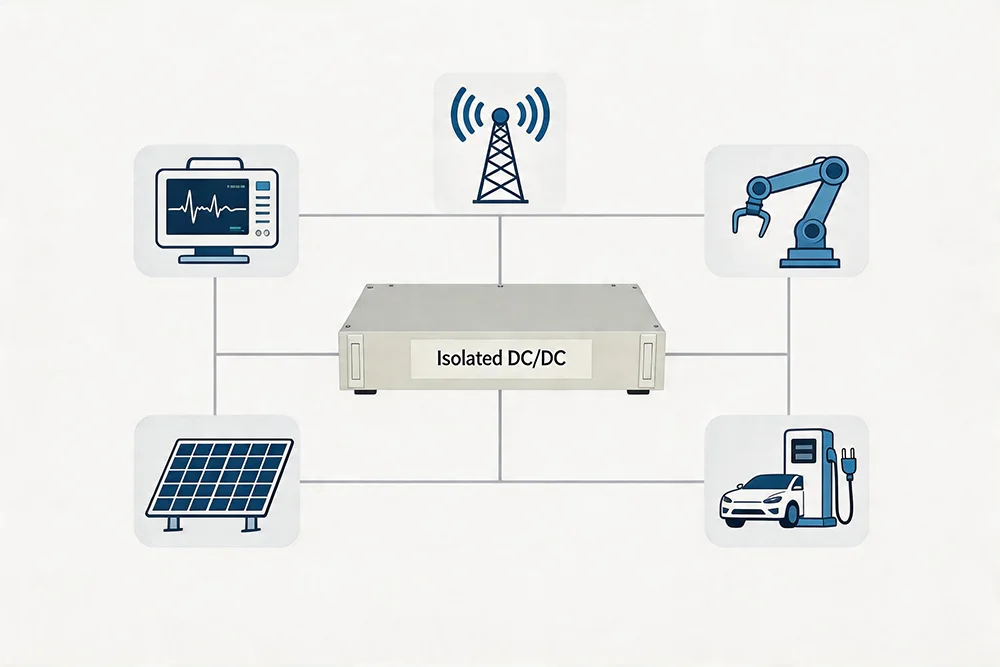
Thanks to their versatility,you’ll find isolated DC/DC converters in countless applications:
- Telecommunications:Powering remote radio heads,base stations,and PoE equipment where-48V DC rails need to generate low-voltage logic supplies.
- Industrial automation:PLCs,sensors,motor drives,and factory robots–isolation protects controllers from high-power sections.
- Medical electronics:Patient monitors,ventilators,imaging systems–stringent leakage current requirements demand medical-grade isolated converters.
- Electric vehicles(EVs)and transportation:Battery management systems(BMS),on-board chargers,and auxiliary power supplies for traction inverters.
- Renewable energy:Solar inverters,battery storage systems,and fuel cell converters where isolation is mandatory for safety.
- Test&measurement:Oscilloscopes,data loggers,and isolated probes to prevent ground loops during measurement.
What to Look for in a High-Quality Isolated DC/DC Converter?
When selecting an isolated DC/DC converter for your project,consider these parameters:
- Input voltage range(wide range is better for battery or unstable supplies)
- Output voltage and power rating(e.g.,5V/2A,12V/1A,or configurable)
- Isolation voltage(1.5 kV,3 kV,4 kV–choose based on safety standards)
- Efficiency(higher efficiency reduces heat and extends life)
- Protection features(overcurrent,overvoltage,short circuit,thermal shutdown)
- Parallel capability–allows scaling power without redesigning the board
Voltruc Isolated DC/DC Converters:Full Protection and Up to 8 Units Parallel
When you need a reliable,robust,and scalable solution,Voltruc offers a family of isolated DC/DC converters engineered for the toughest environments.Voltruc’s converters stand out because they combine comprehensive protection features with unmatched parallel operation capability–supporting up to 8 devices in parallel without external controllers.
Why Choose Voltruc Isolated DC/DC Converters?
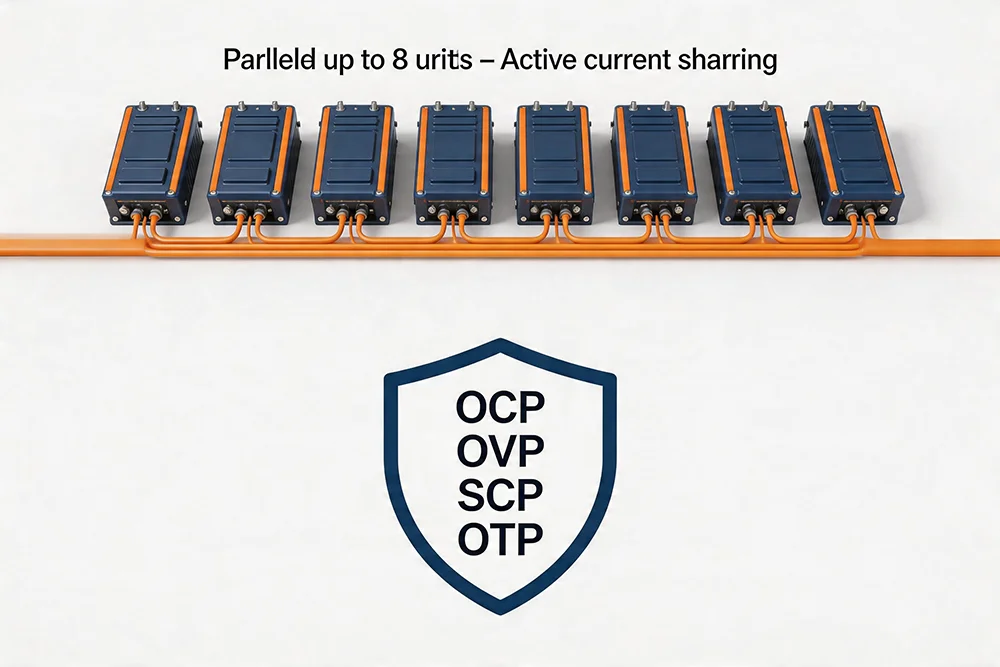
- Full Protection Suite:Over-current protection(OCP),over-voltage protection(OVP),short-circuit protection(SCP),and over-temperature protection(OTP).No more blown modules–Voltruc designs self-recovering protection.
- Parallel Up to 8 Units:Need more output power?Simply connect up to eight Voltruc isolated DC/DC converters in parallel.Active current sharing ensures balanced load distribution,increasing total power without single points of failure.Perfect for N+1 redundancy or capacity expansion.
- Wide Input Range:9-36V,18-75V,or 40-160V options cover battery,industrial,and railway standards.
- High Efficiency:Up to 92%typical,reducing cooling requirements and improving system MTBF.
- Compact&Industrial Grade:Encapsulated modules for vibration,moisture,and dust resistance.Operating temperature from-40°C to+85°C.
Example Applications with Voltruc Parallel Capability
| Application | Power Requirement | Voltruc Solution |
|---|---|---|
| 5G telecom base station | 300W at 12V | 4 x 75W isolated converters in parallel |
| Medical imaging system | 480W at 24V | 6 x 80W units with redundancy |
| Industrial robot controller | 200W at 48V | 2 x 100W + 1 redundant (N+1) |
| EV auxiliary battery charger | 600W at 13.8V | 8 x 75W modules for high current |
Unlike many competitors whose parallel capability is limited to 2 or 3 units,Voltruc’s advanced control IC and dedicated current-sharing pins allow seamless scaling from one to eight modules.This gives you design flexibility–start with one converter and add more as your system grows,all without changing PCB layout.
How to Get Started with Voltruc Isolated DC/DC Converters
Integrating a Voltruc isolated DC/DC converter is straightforward.Each module comes with a detailed datasheet,application notes for parallel operation,and thermal derating curves.Voltruc also provides evaluation boards so you can test parallel performance before committing to mass production.
Whether you are designing a ruggedized industrial power supply,a medical device with stringent safety requirements,or a telecom system needing high reliability,Voltruc’s isolated DC/DC converters deliver the performance,protection,and scalability you need.
Upgrade Your Power Design with Voltruc–Full protection+up to 8 units parallel–engineered for demanding applications.Contact Voltruc for samples"es.
Frequently Asked Questions(FAQ)
- Q1:What is an isolated DC/DC converter in simple terms?
- A:It’s a device that changes one DC voltage to another DC voltage while physically separating the input and output circuits using a transformer.This separation prevents electric shock,eliminates ground noise,and protects equipment.
- Q2:When should I use an isolated vs non-isolated converter?
- A:Use isolation when safety(high voltage separation),ground loop elimination,or large voltage differences are involved.Non-isolated converters are cheaper and smaller for simple voltage regulation on the same PCB.
- Q3:Can I really parallel 8 Voltruc isolated converters?
- A:Yes.Voltruc’s design includes active current sharing with a dedicated bus.Simply connect the“share”pins together,tie outputs(with proper wiring),and the modules will automatically balance load current up to 8 units.
- Q4:What protections do Voltruc converters include?
- A:Over-current,over-voltage,short-circuit,and over-temperature protection.All protections are auto-recovering(non-latching)for maximum uptime.
Conclusion
Now you have a complete answer to what is an isolated DC/DC converter and why it’s essential in modern power design.From safety and noise immunity to breaking ground loops,the benefits are clear.And when you need a rugged,highly protected,and scalable solution,Voltruc’s isolated DC/DC converters with full protection and support for up to 8 parallel units offer unmatched flexibility.Reduce your design risk,improve power density,and future-proof your system with Voltruc.
Ready to integrate high-performance isolated DC/DC conversion into your next project?Explore Voltruc’s product line today.