
When you’re setting up a solar system,kitting out an RV,or preparing for unexpected power outages,one question inevitably comes up:what can a 3000 watt inverter run?It’s a smart question,because choosing the right inverter capacity makes all the difference between a reliable backup system and a frustrating underpowered setup.
A 3000 watt inverter is widely regarded as the“sweet spot”for off-grid and home backup applications,offering enough continuous capacity to handle multiple heavy-duty appliances without the high cost of industrial-sized equipment.But what exactly does that mean in practical terms?What devices can you actually power,and for how long?Let’s break it all down.
Understanding Your 3000 Watt Inverter:The Basics
Before diving into specific appliances,it helps to understand a few key concepts.A 3000 watt inverter converts DC power from batteries(or solar panels)into AC power that your household appliances can use.The“3000 watts”refers to the continuous power the inverter can deliver—but many appliances also require a brief surge of higher power when starting up,known as“starting watts”or“peak load.”
Most quality 3000W inverters can handle surge power up to 6000 watts for short periods,typically 0.3 to 20 seconds,which is crucial for starting motor-driven appliances like refrigerators,pumps,and air conditioners.A good rule of thumb is to keep your continuous loads below 80%of the rated capacity(around 2400W)to leave room for those unexpected startup surges.
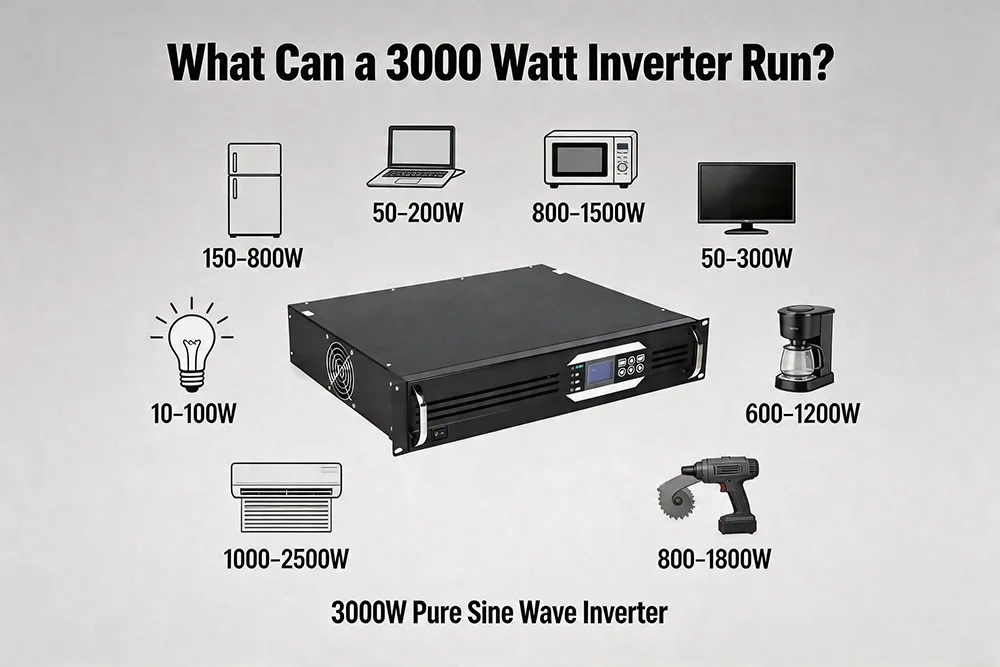
What Can a 3000 Watt Inverter Run?Complete Appliance List
A 3000 watt inverter can power most household appliances one by one,from kitchen essentials to power tools and electronics.Here’s a comprehensive breakdown by category:
🍳Kitchen Appliances
| Appliance | Typical Running Watts | Starting Watts (if applicable) |
|---|---|---|
| Refrigerator (full-size) | 150–800W | 1000–1500W |
| Freezer | 200–700W | 1000–1500W |
| Microwave (standard) | 700–1500W | ~1500W |
| Coffee maker | 600–1200W | N/A |
| Electric kettle | 1500–2200W | N/A |
| Toaster | 700–1000W | N/A |
| Blender | 500–1000W | N/A |
| Rice cooker | 500–1000W | N/A |
| Induction cooktop (small) | 1000–1800W | N/A |
📺 Home Electronics & Lighting
| Device | Typical Watts |
|---|---|
| LED TV (50–65″) | 100–300W |
| Laptop | 50–120W |
| Desktop computer | 200–500W |
| WiFi router | 10–30W |
| Phone/tablet charger | 5–20W |
| LED light bulbs (10 bulbs) | 50–100W |
| Ceiling fan | 50–100W |
🔧 Power Tools & Workshop Equipment
| Tool | Typical Running Watts | Starting Watts |
|---|---|---|
| Electric drill | 500–1000W | 900–1200W |
| Circular saw | 1400–1800W | 1800–2500W |
| Air compressor (small) | 1200–2000W | 2000–3000W |
| Sander | 200–500W | N/A |
| Small welder | 1500–2500W | 3000–4000W |
❄️ Climate Control
| Appliance | Running Watts | Starting Watts |
|---|---|---|
| 5000–10000 BTU window AC | 500–1000W | 1200–2000W |
| 13500 BTU RV AC | 1500–1800W | 2500–3000W |
| Space heater (small) | 750–1500W | N/A |
🚿 Bathroom & Personal Care
| Device | Typical Watts |
|---|---|
| Hair dryer | 1200–1875W |
| Electric iron | 1000–1500W |
| CPAP machine | 30–100W |
🩺 Medical Equipment
| Device | Typical Watts |
|---|---|
| CPAP/BiPAP | 30–100W |
| Refrigerated medication | Included with fridge |
A 3000 watt inverter can comfortably run a standard microwave(800–1500W),a coffee maker(800–1200W),and a full-sized refrigerator(350–800W running)simultaneously—that’s the kind of versatility that makes this capacity so popular.
How Long Will a 3000 Watt Inverter Run?
The runtime of your 3000 watt inverter depends almost entirely on two factors:the battery capacity you have and the total power draw of the appliances you’re running.
Here’s the simple formula to calculate runtime:
Runtime(hours)≈(Battery Capacity(Ah)×Battery Voltage×Inverter Efficiency)÷Load Power(W)
Most inverters operate at 85–95%efficiency,meaning some energy is lost during conversion.For practical planning,assume around 90%efficiency.
Let’s look at real-world examples based on different usage scenarios.
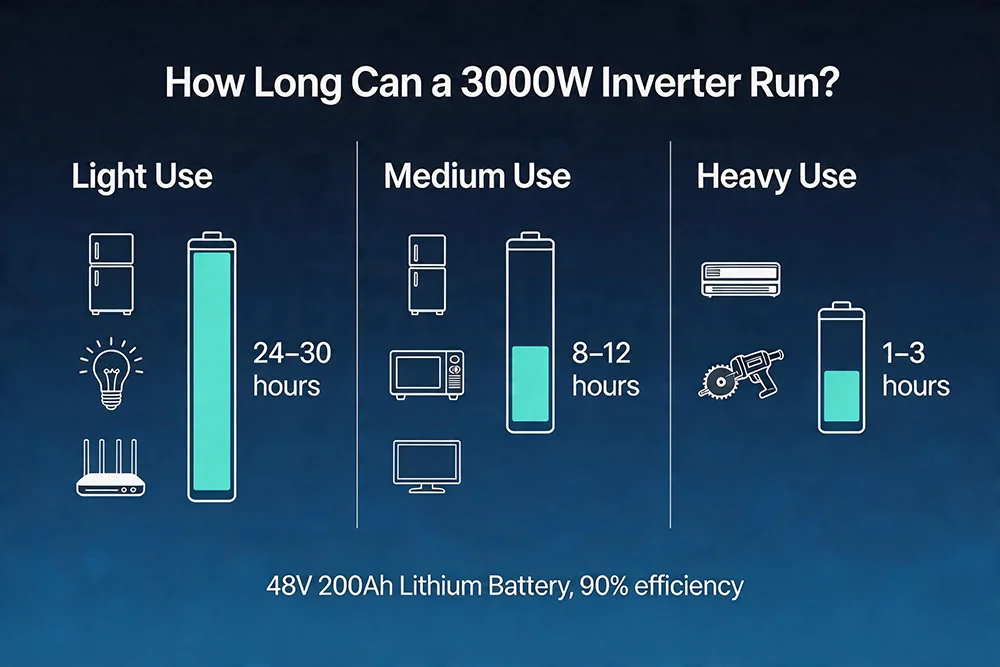
Home Application Runtime Scenarios
To help you plan effectively,I’ve broken down home backup use into three categories:light use,medium use,and heavy use.These estimates assume a 48V 200Ah lithium battery bank(a common and well-balanced setup for 3000W inverters),which provides roughly 9,600 watt-hours of total energy.
📋Light Use:Essentials Only(Estimated Runtime:24–30 hours)
In a light-use scenario,you’re powering only the absolute essentials to ride out a short outage comfortably.
Typical Load:
- Refrigerator(cycling:~150W average)
- LED lights throughout the house(100W)
- WiFi router and charge a couple of devices(30W)
- TV for evening entertainment(150W)
Total average draw:~400–500W
With a 48V 200Ah battery bank,this setup can easily last 24 to 30 hours.That’s enough to get through a full day and night of outage without feeling too cramped.Some setups with efficient refrigerators and larger battery banks(400Ah)can keep a fridge and lights running for 24–30 hours easily.
💡Best for:Short to moderate outages(1–2 days),overnight camping in an RV,or maintaining essential functions during a grid disruption.
🔄Medium Use:Comfortable Living(Estimated Runtime:8–12 hours)
Medium use adds a few more conveniences—cooking,coffee,and moderate use of kitchen appliances—while still being mindful of battery drain.
Typical Load:
- Refrigerator(cycling:~150W average)
- LED lighting(100W)
- TV and router(150W)
- Microwave use(1000W for 5–10 minutes per meal)
- Coffee maker(800–1200W for 5 minutes in the morning)
- Laptop charging(60W)
Average draw over 24 hours:~800–1000W(accounting for intermittent high-draw appliances)
With a 48V 200Ah battery bank,you can expect 8 to 12 hours of runtime under medium load.If you use your microwave for 10 minutes,that alone consumes about 167 watt-hours,which is negligible compared to the 9,600Wh total available.
To put it in perspective:drawing 2000W from a 300Ah 12V battery bank yields about 1.2 hours at full load,but reducing your draw to 1500W extends runtime significantly.With a 48V system,those numbers improve dramatically.
💡Best for:Daytime outages where you still want to cook meals and live relatively normally,or longer off-grid weekends where you use appliances moderately.
⚡Heavy Use:High-Power Appliances(Estimated Runtime:1–3 hours)
Heavy use means you’re running multiple high-wattage appliances simultaneously or for extended periods—think air conditioning,power tools,hair dryers,or space heaters.
Typical Load:
- 13500 BTU RV air conditioner(1500–1800W running,2800W starting)
- Refrigerator(150W)
- Microwave or hair dryer(1200–1500W)
- Power tools(circular saw:1400–1800W)
Total draw:~2500–3000W
A 3000W inverter pulling full load from a 300Ah 12V battery bank runs for about 1.2 hours max.With a 48V 200Ah lithium setup,you’re looking at roughly 1 to 3 hours,depending on whether you’re sustaining maximum load continuously or using high-wattage appliances in short bursts.
⚠️Important:Motor-driven appliances like air conditioners and power tools require 2–3 times their running wattage at startup,which can momentarily spike to 6000W or more.A quality inverter with 6000W peak capacity is essential for this usage level.
💡Best for:Construction sites,remote workshops,food trucks,or short bursts of high-power needs during an outage(like running a sump pump or well pump).
Runtime Comparison Table(48V 200Ah Lithium Battery)
| Usage Level | Typical Devices | Average Load | Estimated Runtime |
|---|---|---|---|
| Light Use | Fridge + lights + router + TV | 400–500W | 24–30 hours |
| Medium Use | Fridge + lights + microwave + coffee maker + TV | 800–1000W | 8–12 hours |
| Heavy Use | AC + power tools + hair dryer + full load | 2500–3000W | 1–3 hours |
Note:These are estimates.Actual runtime varies based on battery chemistry(lithium vs.lead-acid),inverter efficiency,temperature,and the age of your batteries.For lead-acid batteries,usable capacity is only about 50%,so cut these runtimes roughly in half.
48V vs.12V:Which Battery System Is Best for a 3000W Inverter?
This is a critical decision.A 3000W inverter pulling from a 12V source draws roughly 250 amps of continuous current.That creates significant heat and requires massive cabling(1/0 AWG or larger).
A 48V system is strongly recommended for 3000W inverters.At 48V,the current draw drops to just 62.5 amps—a massive reduction that means smaller cables,less heat,and better efficiency.Many experts suggest 150Ah–200Ah for a 48V system,providing roughly 5 hours of heavy use or much longer for lighter loads.
What a 3000 Watt Inverter Cannot Run
While a 3000W inverter is impressively versatile,it does have limits.It will not run:
- Electric clothes dryers(typically 4000–6000W)
- Large central air conditioning units(3500W+running,much higher starting)
- Electric water heaters(3500–4500W)
- Large welders or industrial machinery
- Multiple high-wattage appliances simultaneously(keep total under 3000W continuous)
However,it’s more than enough for most home backup needs—refrigerators,freezers,TVs,microwaves,and just about everything else you’d need during an outage.
Why Choose Voltruc for Your 3000 Watt Inverter?
When investing in a power inverter,quality and reliability matter.Voltruc has established itself as a trusted name in the inverter industry,offering a compelling combination of features that make them an excellent choice for homeowners,RV enthusiasts,and off-grid adventurers alike.
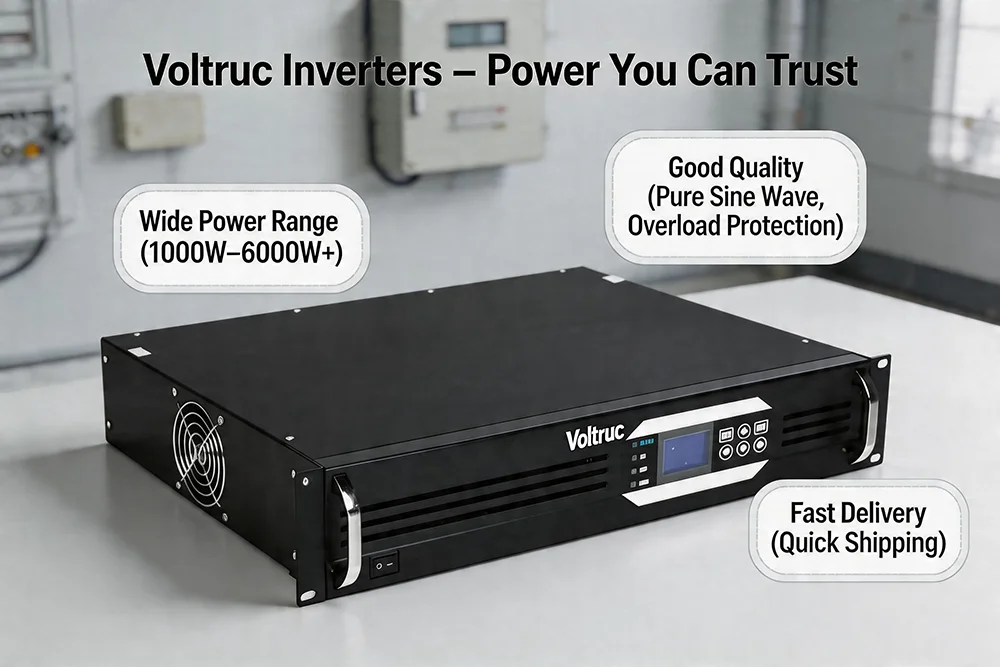
Wide Power Range for Every Need
Voltruc manufactures inverters across a broad spectrum of power ratings,from compact units for basic device charging all the way up to heavy-duty systems capable of powering entire workshops.This means you can find the perfect fit for your specific requirements,whether you need a small 1000W unit for camping or a robust 3000W+system for whole-home backup.And if your power needs grow over time,Voltruc’s product lineup allows for easy system expansion.
Superior Build Quality and Clean Power
Voltruc inverters are engineered with high-grade components and advanced transformer technology,delivering pure sine wave output that matches the clean power you get from the grid.This is crucial for protecting sensitive electronics—laptops,medical equipment,modern TVs,and smart appliances—from voltage fluctuations that cheaper inverters can cause.Pure sine wave power also ensures motor-driven appliances(refrigerators,pumps,power tools)run cooler,quieter,and more efficiently,extending their lifespan.
Fast Delivery When You Need It Most
In the power inverter business,speed matters.Voltruc maintains substantial inventory and optimized logistics networks,allowing them to fulfill orders quickly whether you’re a homeowner preparing for storm season,an RV owner planning a trip,or a business stocking up for job sites.Their fast delivery times mean you won’t be left waiting weeks for essential backup power.
Trusted by Professionals and DIYers Alike
Voltruc inverters come equipped with comprehensive protection features—overload protection,over-temperature shutdown,low-voltage alarm,and short-circuit protection—giving you peace of mind whether you’re installing the unit yourself or relying on it for critical backup power.Their customer support team is responsive and knowledgeable,helping you select the right model and troubleshoot any issues.
For a 3000 watt inverter that balances power,reliability,and value,Voltruc is a brand worth serious consideration.
Final Thoughts
So,what can a 3000 watt inverter run?The short answer:most of your essential household appliances,plus some nice-to-haves like a microwave,coffee maker,power tools,and even a small air conditioner.It’s the ideal balance of power and practicality for home backup,RV living,and off-grid setups.
The longer answer depends on your battery capacity and usage patterns.With light use focusing on essentials,a 48V 200Ah lithium setup can power your home for a full day or more.Medium use—adding cooking and entertainment—gives you 8–12 hours of comfortable living.And heavy use with air conditioning or power tools is best reserved for shorter bursts of 1–3 hours.
Ready to build your backup power system?Start by assessing your actual power needs(make a list of the appliances you truly want to run),then size your battery bank accordingly using the runtime formula above.And when you choose your inverter,consider a quality pure sine wave model from a trusted brand like Voltruc—because when the power goes out,reliability is everything.