
Home » N+1 Redundancy — DT2000 110v
DT2000 Series Parallel Power Inverters (110 VDC / 220 VDC)
N+1 Parallel Redundancy Design | Masterless Parallel Technology | Up to 8 Modules in Parallel | Real-time Data Acquisition | Suitable for High-Power Applications
- 🔗 N+1 Parallel Redundancy
- 👑 Masterless Parallel Technology
- 🧩 Up to 8 Modules in Parallel
- 📈 Real-time Data Acquisition
- ⚡ 110V/220V High-Voltage DC Input
- DC Input Voltage: 110 Vdc / 220 Vdc
- AC Output Voltage: 220 Vac
- Module Power Range: 3 kVA – 10 kVA
- Maximum System Cabinet Power: 80 kVA
- Output Frequency: 50 Hz (±0.1%)
- Inversion Efficiency: ≥90%
- Parallel Current Imbalance: <3%


| Feature | Description |
|---|---|
| N+1 Parallel Redundancy Design | Supports parallel connection of multiple modules; failure of any module does not affect system power supply, significantly improving system reliability |
| Masterless Parallel Technology | No need to set master or slave modules; any module can operate independently, with automatic current sharing during parallel operation, simplifying installation and maintenance |
| 32-bit Digital DSP Control | Uses high-speed digital signal processor combined with high-frequency SPWM technology for high control precision and fast dynamic response |
| Up to 8 Modules in Parallel | A single system cabinet can support up to 8 modules in parallel, offering flexible power expansion with a maximum capacity of 80KVA |
| Real-time Data Acquisition | Monitors parameters such as input voltage, output voltage, current, frequency, and temperature in real time, facilitating operation and maintenance management |
| Remote Communication | Supports RS485 communication, with optional SNMP card for easy integration into power system monitoring platforms |
| Configurable Transfer Priority | Allows flexible setting of inverter priority or bypass priority based on application requirements, adapting to different power supply scenarios |
| Compact 2U Design | Each module is only 2U in height, offering high power density and saving cabinet space |
| Product form | Rated power | 1KVA | 2KVA | 3KVA | 5KVA | 6KVA |
|---|---|---|---|---|---|---|
| Dimensions (Width×height×depth)(mm) | 19"2U | 19"2U | ||||
| 490×88×385 | 490×88×392 | |||||
| Input parameter | DC input voltage | 110VDC | ||||
| AC input Current | 4.55A | 9.1A | 13.6A | 22.7A | 27.3A | |
| DC input range | 92~142VDC | |||||
| Bypass input range | 176~264VAC | |||||
| Bypass switching time | Electronic type<5ms(external) | |||||
| Mechanical type<20ms | ||||||
| Ac output | Rated output voltage | 220VAC | ||||
| Rated output frequency | 50Hz | |||||
| Load regulation | <1% | |||||
| Frequency accuracy | <0.1% | |||||
| peak factor | 3:01 | |||||
| Waveform distortion | Resistance full load<3%,nonlinear full load<5% | |||||
| Dynamic response | Voltage transient range<3%,transient response recovery time≤60ms(load from 0 to 100) | |||||
| Parallel uneven flow | <3% rated current RMS | |||||
| Overload capacity | Load current <105%, continuous work | |||||
| Load current 105~125%, continuous work 10min shutdown | ||||||
| Load current 125~150%,continuous work after 1min shutdown | ||||||
| Load current>150%,after 20ms shutdown | ||||||
| Protection function | Input connection protection, input under voltage and over-voltage protection, output overload protection, output short circuit protection, over temperature protection | |||||
| Communication | Communication interface | RS485 | ||||
| Work environment | Insulation strength | 2KVac,1min | ||||
| Noise (1 m) | <45dB | |||||
| Operating ambient temperature | -10~50℃ | |||||
| Transport and storage temperature | -40~70℃ | |||||
| Relative humidity | 0~90%, no condensation | |||||
| Relative altitude (M) | ≤3000m,1500~3000m, 1% decrease in output for every 100 m increase | |||||
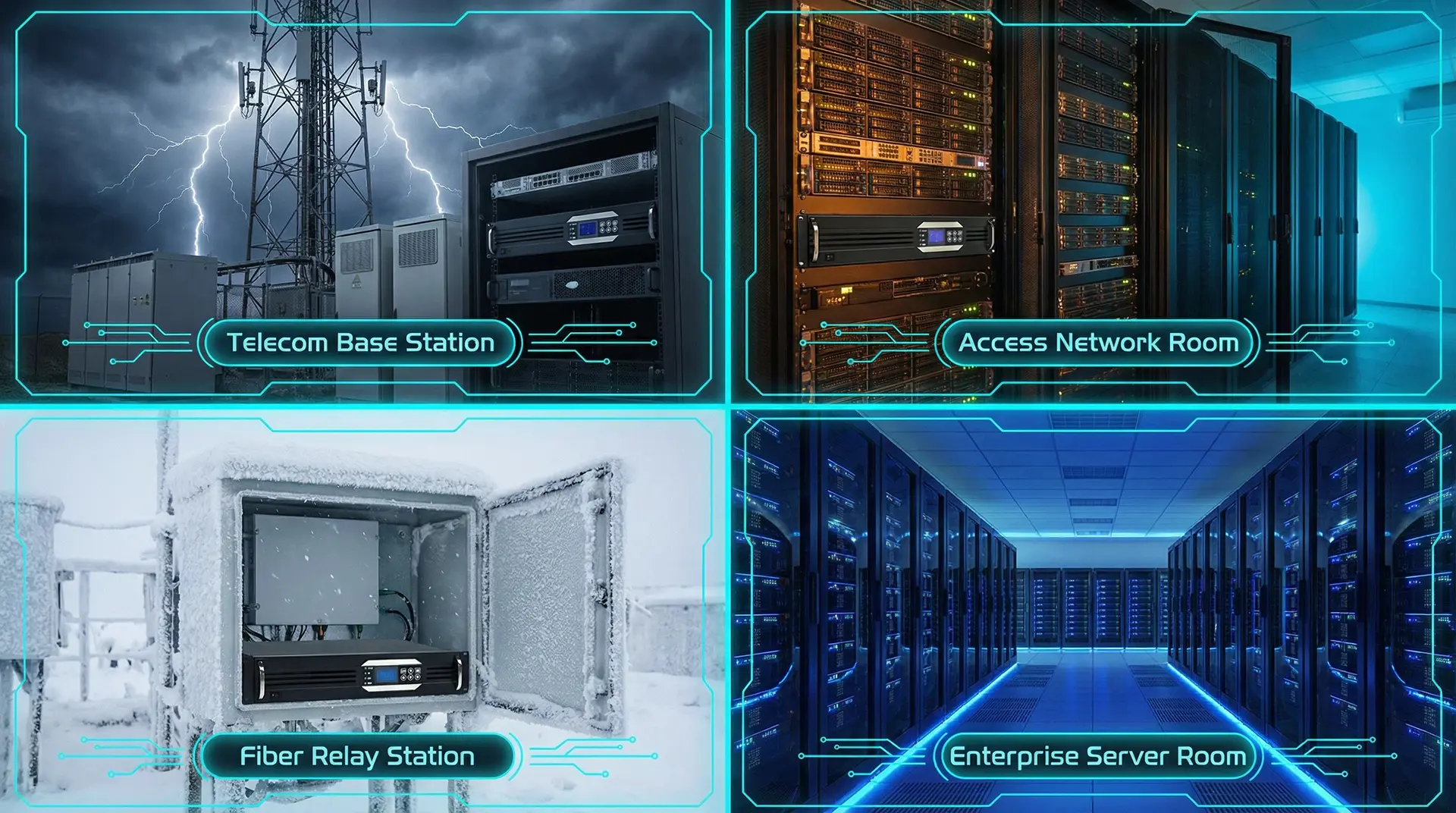
| Large Substation | 🏭 | Provides N+1 redundant power supply for AC loads within the station, ensuring reliable operation of relay protection and monitoring systems |
|---|---|---|
| Power Plant Complex Building | ⚡ | Modular design allows on-demand expansion to meet the power supply requirements of various AC loads in the power plant |
| Data Center | 🖥️ | Parallel redundancy design, combined with STS, enables a high-availability power architecture |
| Large Industrial and Mining Enterprises | 🏗️ | Provides highly reliable inverter power for production line control systems and critical equipment |
| Rail Transit | 🚄 | Suitable for high-power AC power supply scenarios in substations along subways and railway lines |
What is the difference between the DT2000 and the DT1500?
The DT2000 focuses on high-voltage DC inputs (110/220V) for power systems; it employs masterless parallel technology and supports the parallel operation of up to 8 modules. The DT1500 covers both telecommunications and power system voltage ranges; it features a modular, hot-swappable design and supports the parallel operation of up to 4 modules.
What is the maximum number of modules that can be connected in parallel?
A single system cabinet supports the parallel operation of up to 8 modules, with a total power output reaching up to 80 kVA. For higher power requirements, multi-cabinet parallel solutions can be customized.
What is "masterless parallel technology"?
Traditional parallel systems require the designation of a “master” unit and “slave” units; if the master unit fails, the entire system may be compromised. With masterless technology, all modules operate on an equal footing—any module can function independently, and current sharing is automatically balanced during parallel operation, resulting in significantly higher reliability.
Can the dimensions of the system cabinet be customized?
Yes. The standard cabinet sizes are 42U, 45U, and 48U; however, the power distribution configuration, IP protection rating, and physical dimensions can all be customized to meet specific project requirements.
What is the transfer time?
For a single module, the transfer time from bypass mode to inverter mode is ≤8 ms. When the system cabinet is equipped with a built-in Static Transfer Switch (STS), the switching time is ≤4 ms, thereby meeting the stringent switching-time requirements of critical loads.
How is remote monitoring achieved?
The modules come standard with an RS485 interface, and the system cabinet offers an optional SNMP card; this enables integration with power system monitoring platforms, facilitating real-time remote monitoring.