
Have you ever wondered how your laptop charges from a car battery,or how solar panels power your home appliances?The answer lies in a remarkable device called an inverter.But how does an inverter work exactly?
In simple terms,an inverter is an electronic device that converts direct current(DC)electricity into alternating current(AC)electricity.This conversion is essential because most household appliances,office equipment,and industrial machinery run on AC power,while many energy sources—such as batteries,solar panels,and fuel cells—generate DC power.
This comprehensive guide will explain the science behind inverters,how they convert DC to AC step by step,their core components,different waveform types,real-world applications,and why choosing a reliable inverter matters.
What Is an Inverter?Understanding the Basics
Before diving into how an inverter works,let’s clarify the two types of electricity:
- Direct Current(DC):Electricity flows steadily in one direction.DC provides constant voltage and current,making it ideal for batteries,solar panels,and electronic circuits.
- Alternating Current(AC):Electricity repeatedly reverses direction,oscillating in a sinusoidal pattern.Standard household AC power oscillates 50 or 60 times per second(50Hz or 60Hz),depending on your country.
An inverter bridges the gap between these two forms of electricity.It takes the DC power stored in batteries or generated by solar panels and transforms it into usable AC power that can run your refrigerator,TV,lights,and other appliances.
How Does an Inverter Work?Step-by-Step Explanation
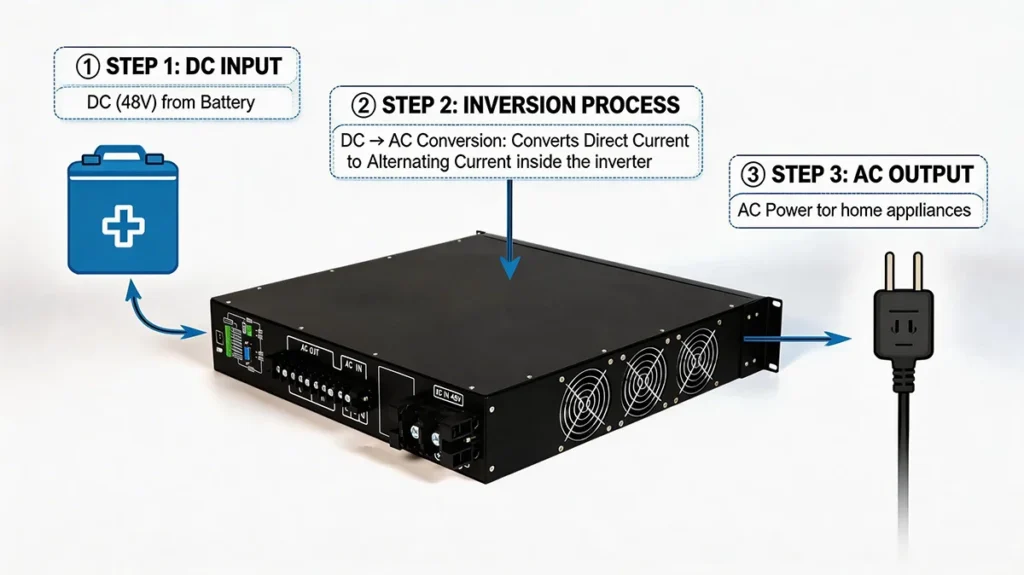
The DC-to-AC conversion process involves several key stages.Here’s a step-by-step breakdown of how an inverter works:
Step 1:DC Power Input
The inverter receives direct current from a DC source such as a battery(typically 12V,24V,or 48V),solar panel array,or fuel cell.This DC power flows steadily in one direction.
Step 2:Electronic Switching(The H-Bridge Circuit)
The heart of the inverter is the switching stage,often built as an H-bridge circuit using four semiconductor switches(transistors such as MOSFETs or IGBTs).These switches rapidly turn the DC current on and off and reverse its direction,creating an alternating waveform.
Think of it like rapidly flipping a light switch—by controlling the timing and sequence of these switches,the inverter creates a pulsed waveform that mimics AC.
Step 3:Pulse Width Modulation(PWM)
To produce a smooth,usable AC waveform,the inverter uses Pulse Width Modulation(PWM)technology.A control circuit adjusts the width of each pulse—wider pulses for higher voltage,narrower pulses for lower voltage—to shape the output waveform to closely resemble a pure sine wave.Modern microcontrollers execute PWM algorithms while monitoring output via voltage and current sensors,adjusting pulse widths in microseconds to maintain stable voltage and frequency.
Step 4:Filtering and Smoothing
The raw switched output contains high-frequency noise and harmonic distortion.The inverter passes this output through an LC filter(inductor-capacitor combination)that smooths the waveform,removing unwanted frequencies and producing a clean AC output suitable for sensitive electronics.
Step 5:Voltage Transformation
In many inverters,the filtered AC signal then passes through a step-up transformer that raises the voltage from the battery level(e.g.,12V,24V,or 48V)to standard household voltage(110V,120V,or 230V AC).
The final result is clean,stable AC power that can safely power your home appliances.
Core Components of an Inverter
To fully understand how does an inverter work,it helps to know its key components:
| Component | Function |
|---|---|
| Oscillator Circuit | Generates the timing signal that controls switching frequency |
| Switching Transistors (MOSFETs/IGBTs) | Rapidly switch DC current on/off to create AC pulses |
| H-Bridge Configuration | Four switches arranged to alternate current direction |
| PWM Controller | Adjusts pulse widths to shape the output waveform |
| LC Filter | Smooths the waveform by removing high-frequency noise |
| Transformer | Steps up voltage to household levels |
| Control Circuit (Microcontroller) | Monitors output and adjusts parameters in real time |
Types of Inverter Output Waveforms
Not all inverters produce the same quality of AC power.The output waveform quality determines which devices an inverter can safely power.
1.Square Wave Inverters
These produce very rough AC power with sharp voltage transitions.While simple and inexpensive,square wave inverters can damage sensitive electronics,create interference,and are limited to basic applications like resistive heating loads.
2.Modified Sine Wave(or Square Wave)Inverters
These generate a stepped AC output that approximates a sine wave.They are suitable for simple loads like power tools and incandescent lights but may cause noise,extra heat,reduced efficiency,and compatibility issues with some devices.
3.Pure Sine Wave Inverters
These produce AC power nearly identical to utility grid electricity.Pure sine wave inverters ensure safe operation,high efficiency,minimal noise,and reliable performance for sensitive electronics such as computers,medical devices,audio equipment,and variable-speed appliances.They are the preferred choice for most residential and commercial applications.
Why Are Inverters Needed?Key Applications
Inverters play a vital role in modern energy systems.Here are the most common applications:
Renewable Energy Systems(Solar&Wind)
Inverters are essential components in solar power systems,converting the DC electricity generated by solar panels into AC electricity compatible with the grid and home appliances.Advanced solar inverters also use Maximum Power Point Tracking(MPPT)algorithms to optimize energy harvest from solar panels.
Backup Power&Uninterruptible Power Supply(UPS)
When utility power fails,inverters convert stored DC battery power into AC to keep critical devices running—from servers and medical equipment to home lighting and refrigeration.
Electric Vehicles(EVs)&Hybrid Vehicles
Inverters convert DC power from the vehicle’s battery into AC to drive the electric motor and power onboard systems such as air conditioning.
Off-Grid Living&Remote Areas
For cabins,RVs,boats,and remote homes without grid access,inverters enable the use of standard household appliances by converting DC battery or solar power into usable AC.
Industrial&Commercial Applications
In factories,inverters regulate electric motor speeds and power output to improve efficiency,reduce energy waste,and optimize operations for pumps,fans,elevators,and conveyor systems.
Portable Power for Outdoor Activities
Power inverters allow you to run laptops,TVs,microwaves,and other devices from your vehicle’s battery during camping trips or outdoor adventures.
Benefits of Using an Inverter
| Benefit | Description |
|---|---|
| Reliable AC Power Anywhere | Convert DC power into usable AC electricity, allowing standard appliances to operate in locations without grid access |
| Backup Power During Outages | Provide immediate power when the utility grid fails, keeping essential devices running without interruption |
| Support for Renewable Energy | Enable solar panels and batteries to supply AC power, making renewable energy practical for homes and businesses |
| Safe for Sensitive Electronics | Pure sine wave inverters deliver clean, stable power that protects computers, medical devices, and audio equipment |
| Energy Independence | Reduce reliance on the utility grid and give users more control over their power supply |
| High Efficiency | Modern inverter designs minimize energy loss, improving overall system efficiency and battery life |
Voltruc Inverters:Reliable Power for Every Need
When it comes to choosing a high-quality inverter for your home,business,or renewable energy system,Voltruc stands out as a trusted name in power conversion technology.
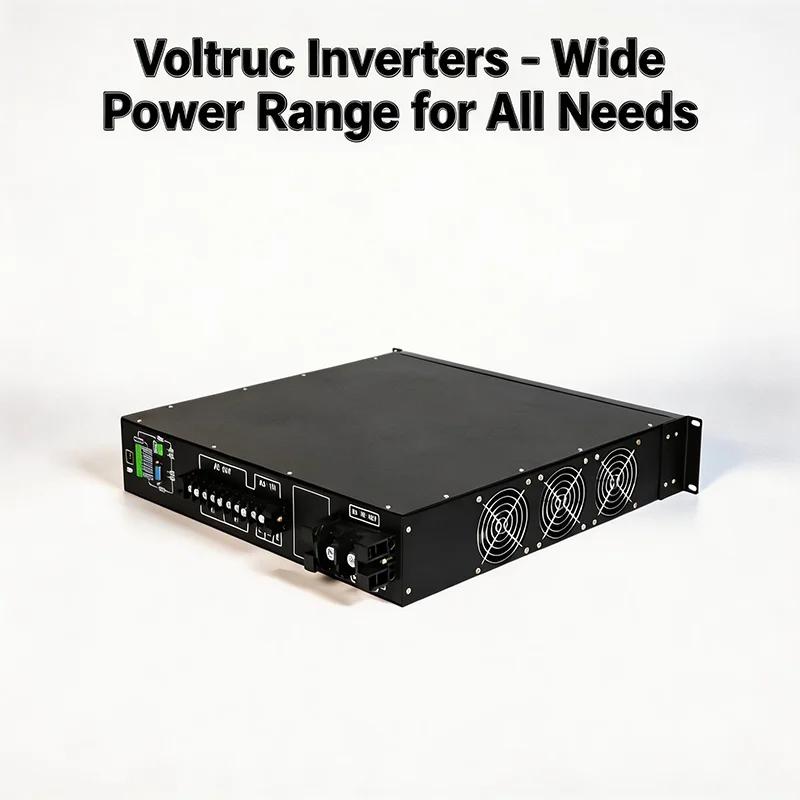
Voltruc offers an extensive range of inverters covering a wide power spectrum,from compact 1kW units for small appliances and RVs to powerful industrial-scale systems exceeding 100kW.Whether you need a pure sine wave inverter for sensitive electronics,a solar inverter for your rooftop PV system,a hybrid inverter for battery storage integration,or an off-grid inverter for remote living,Voltruc has a solution tailored to your specific requirements.
What makes Voltruc the right choice?
- Wide Power Range:Voltruc’s inverter lineup spans from low-wattage portable units to high-capacity industrial systems,ensuring you find the perfect match for your power needs.
- Pure Sine Wave Output:All Voltruc inverters deliver clean,stable pure sine wave AC power that safely operates sensitive electronics,medical devices,and modern appliances.
- High Efficiency:Advanced switching technologies and intelligent control algorithms achieve industry-leading efficiency ratings,minimizing energy loss and maximizing battery life.
- Built to Last:Robust construction with premium components ensures reliable performance in demanding environments—from extreme heat to cold climates.
- Versatile Applications:Whether you’re powering a remote cabin,equipping a solar farm,setting up a home backup system,or outfitting a commercial fleet,Voltruc has the right inverter for the job.
No matter your power requirement—small or large,residential or industrial,grid-tied or off-grid—Voltruc’s diverse product portfolio is designed to meet customers’unique needs with reliable,efficient,and durable power conversion solutions.
Conclusion
So,how does an inverter work?In short,an inverter converts DC electricity from batteries or solar panels into AC electricity for household and industrial use through electronic switching,PWM modulation,filtering,and voltage transformation.This seemingly simple process powers our modern world—from solar homes and electric vehicles to backup systems and off-grid living.
Understanding inverter technology helps you make informed decisions when selecting power solutions for your home,business,or renewable energy project.And when you need a reliable inverter backed by quality engineering and a wide power range,Voltruc delivers the performance and versatility you deserve.
Frequently Asked Questions(FAQs)
- Q1:Can an inverter run a refrigerator?
- Yes,a properly sized inverter can run a refrigerator.Most refrigerators require 1000W to 2000W of starting surge power.Always check your appliance’s power requirements before selecting an inverter.
- Q2:What size inverter do I need for my home?
- Add up the wattage of all devices you want to run simultaneously,then add 20-30%for safety margin.For a typical home backup,3000W to 5000W inverters are common.
- Q3:What’s the difference between an inverter and a converter?
- A converter changes AC to DC(like a laptop power brick),while an inverter changes DC to AC.They perform opposite functions.
- Q4:How long will an inverter run on a battery?
- Run time depends on battery capacity(amp-hours),load wattage,and inverter efficiency.For example,a 100Ah 12V battery running a 500W load lasts approximately 2-3 hours.
- Q5:Do I need a pure sine wave inverter?
- For sensitive electronics(computers,medical devices,modern TVs,variable-speed tools),yes—pure sine wave is essential.For simple resistive loads like incandescent lights or basic power tools,modified sine wave may suffice.