
Home » STS1000 Static Transfer Switch
STS1000 Series Static Transfer Switch (110 Vac / 220 Vac / 380 Vac)
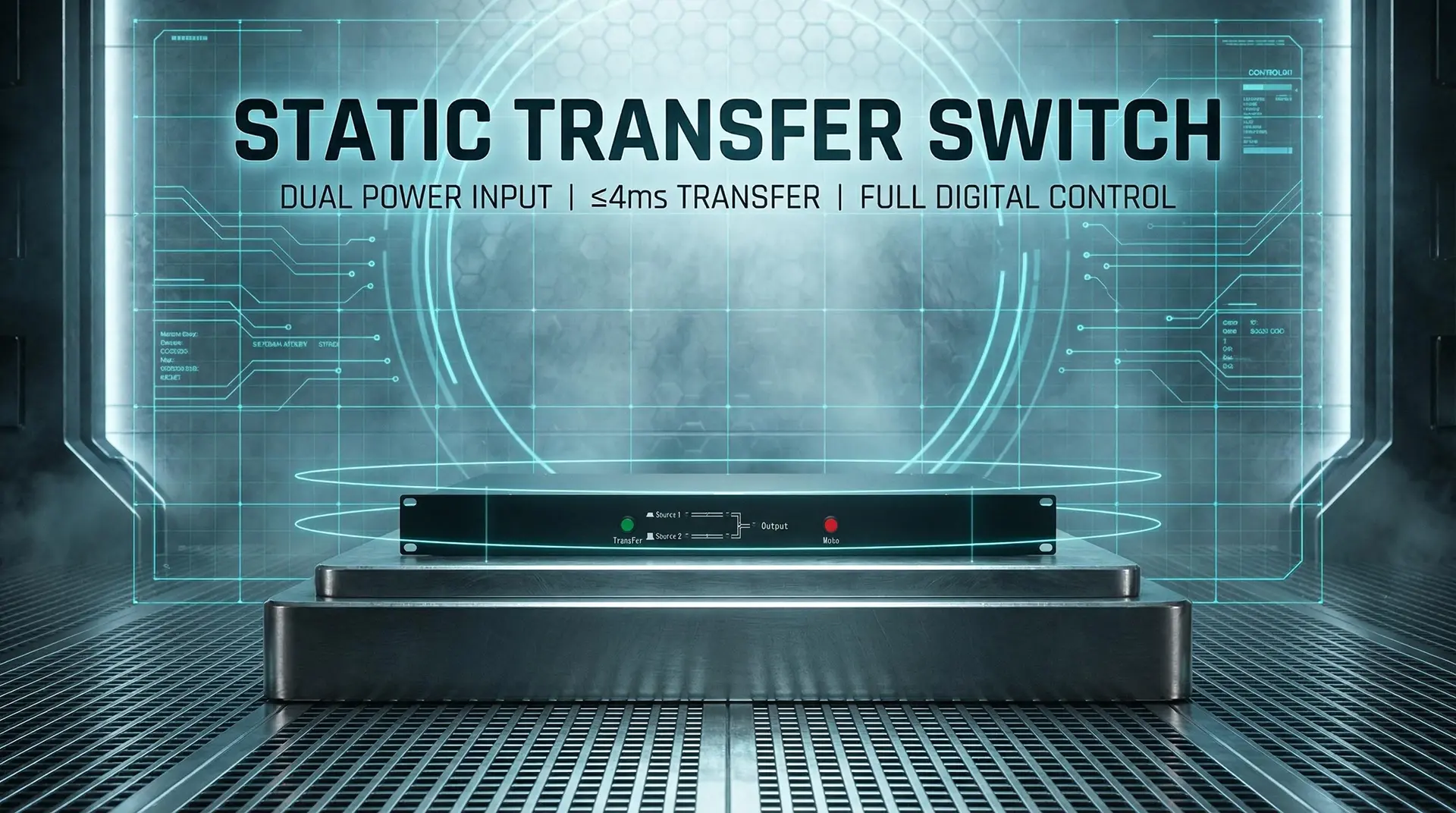
Seamless Dual-Source Power Switching | Switching Time <4ms (Single-Phase) / <6ms (Three-Phase) | Fully Digital Control | Contactless SCR Switching | Suitable for Redundant Power Supply to Critical Loads
- ⚡ Dual AC Power Inputs, Redundant Power Supply
- ⏱️ Switching Time: <4ms (Single-phase) / <6ms (Three-phase)
- 🧠 Fully Digital Control, High Interference Immunity
- 🔌 Contactless SCR Switching, Long Service Life
- 🌐 RS485/SNMP Communication, Dry Contact Outputs
| Parameter | Single-Phase Version | Three-Phase Version |
|---|---|---|
| Input Voltage | 110Vac/220Vac | 380Vac |
| Output Current Range | 16A ~ 125A | 63A ~ 800A |
| Transfer Time | ≤4ms | <6ms |
| Transfer Element | Silicon-Controlled Rectifier (SCR) | Silicon-Controlled Rectifier (SCR) |
| Operating Temperature | -25℃ ~ +50℃ | -25℃ ~ +50℃ |


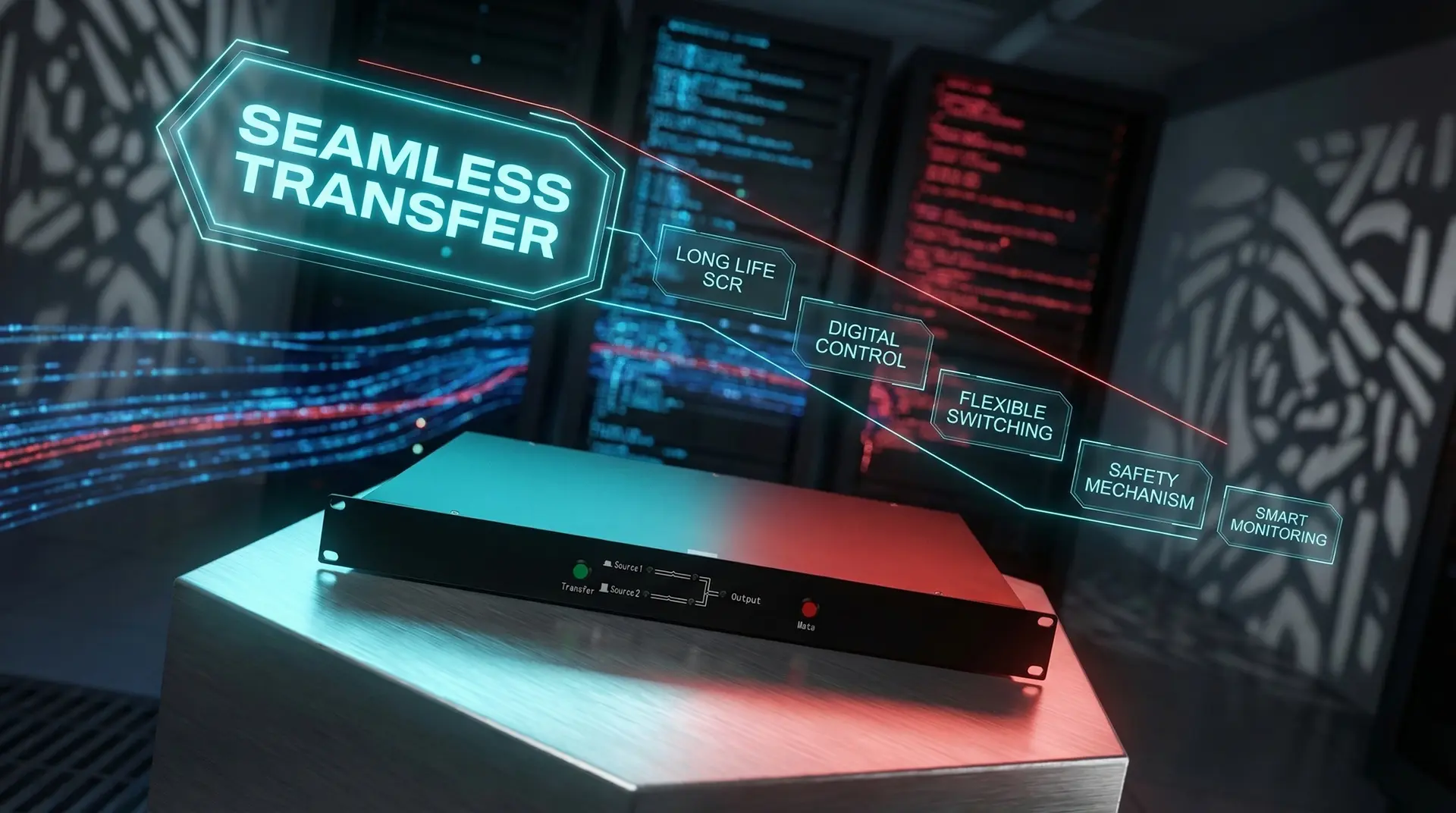
| Fully Digital Control Technology | Uses a high-performance digital processor with strong anti-interference capability, fast computation speed, and high control precision, ensuring stable and reliable operation |
|---|---|
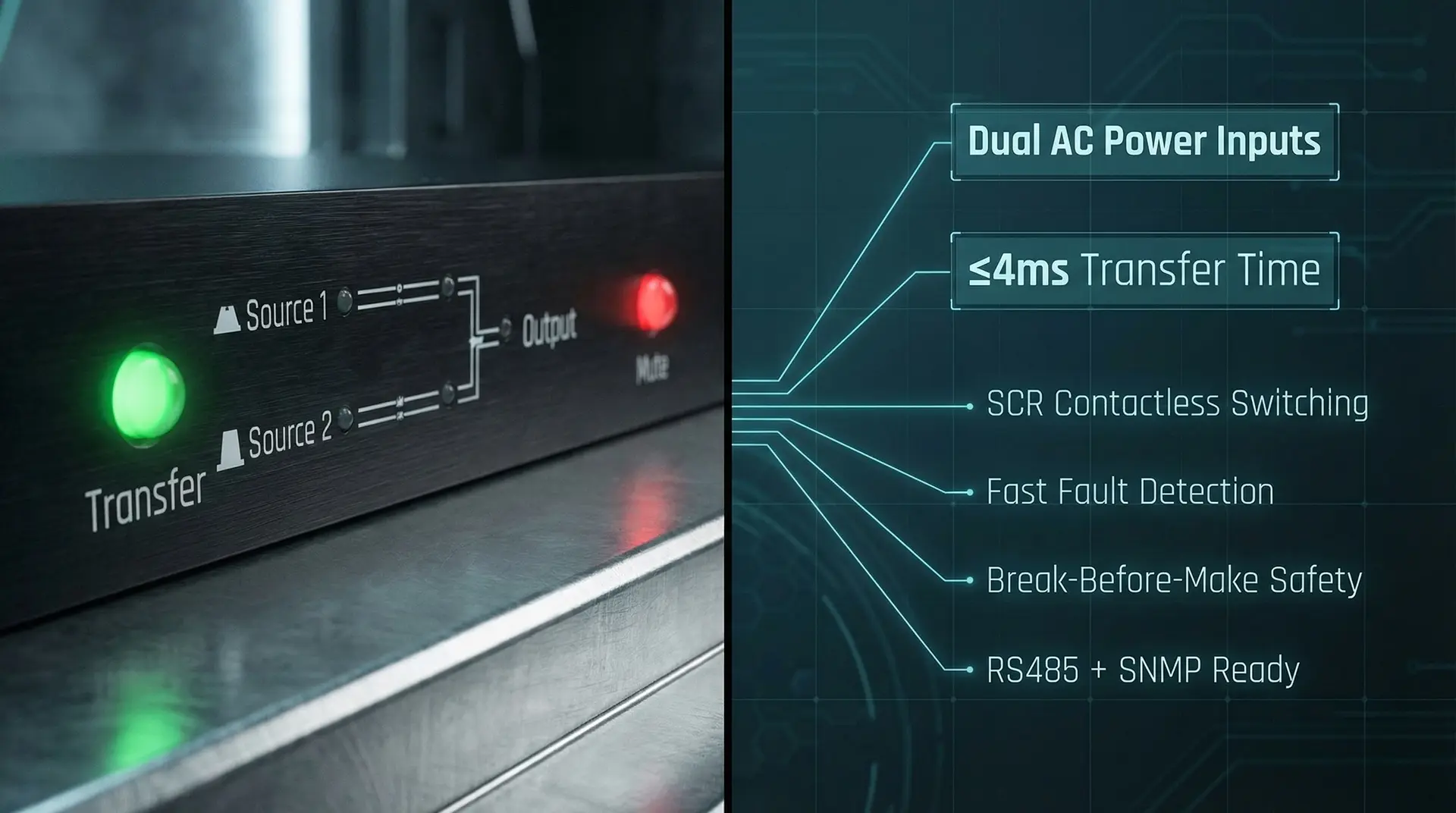
| Dual AC Power Inputs | Supports two independent AC power inputs (primary/backup), providing redundant power supply for critical loads |
| Fast Power Failure Detection | Advanced power failure detection algorithm quickly and accurately identifies input power faults, triggering the transfer action |
| Ultra-Fast Transfer Time | Single-phase version transfer time ≤4ms, three-phase version <6ms, meeting the power continuity requirements of critical loads such as servers and communication equipment |
| Contactless SCR Transfer | Uses silicon-controlled rectifiers (SCRs) as the transfer element, no mechanical contacts, fast transfer speed, long service life, and low maintenance cost |
| Break-Before-Make Switching | Ensures that the two power sources are never paralleled, avoiding the risk of circulating currents and ensuring system safety |
| Multiple Communication Interfaces | Standard RS485 communication and dry contact outputs, with optional SNMP card for easy integration into environmental monitoring systems |
| Flexible Transfer Conditions | Supports automatic transfer based on conditions such as primary power loss, overvoltage, or undervoltage; also supports manual forced transfer |
| Single-Phase Version (110Vac/220Vac) | ||||||||
|---|---|---|---|---|---|---|---|---|
| Model (Single Input) | BWT-STS165 | BWT-STS25S | BWT-STS325 | BWT-STS405 | BWT-STS465 | BWT-STS665 | BWT-STS805 | BWT-STS1050 |
| Model (Dual Input) | BWT-STS160 | BWT-STS250 | BWT-STS320 | BWT-STS340 | BWT-STS450 | BWT-STS630 | BWT-STS800 | BWT-STS1000 |
| Output Current | 16A | 25A | 32A | 40A | 45A | 63A | 80A | 100A/125A |
| Maximum Allowable Current | 18A | 28A | 35A | 45A | 50A | 69A | 88A | 110A/125A |
| Parameter | Specification | |||||||
| AC Input Voltage | 110Vac / 220Vac | |||||||
| AC Voltage Range | 90~130Vac @110Vac; 190~260Vac @220Vac | |||||||
| Effective Operating Voltage | ±12%, hysteresis ±5V | |||||||
| Frequency | 50Hz/60Hz (factory set) | |||||||
| Power Failure Voltage (110V) | ≤55Vac or ≥135Vac, hysteresis ±5V | |||||||
| Power Failure Voltage (220V) | ≤190Vac or ≥260Vac, hysteresis ±5V | |||||||
| Power Failure Frequency | ≤45Hz or ≥65Hz, hysteresis ±0.2Hz | |||||||
| Transfer Time | ≤4ms | |||||||
| Overload Capacity | Continuous operation at 110% load current | |||||||
| Transfer Element | Contactless SCR (Silicon-Controlled Rectifier) switching | |||||||
| Transfer Mode | Break-Before-Make | |||||||
| Transfer Conditions | Power loss, overvoltage, or undervoltage on either input | |||||||
| Operating Environment | ||||||||
| Parameter | Specification | |||||||
| Dielectric Strength | 2000Vac/10mA/60s | |||||||
| Humidity | 0%~90%, non-condensing | |||||||
| Operating Temperature | -25℃ ~ +50℃ | |||||||
| Storage Temperature | -40℃ ~ +70℃ | |||||||
| Noise (1m) | ≤55dB | |||||||
| Dimensions | 482 * 343 * 44.5mm (1U) | |||||||
| Communication Interface | RS485 / SNMP | |||||||
| Three-Phase Version (380Vac) | ||||||||
|---|---|---|---|---|---|---|---|---|
| Model (Three-Phase, Shared Neutral) | BWT-STS063SMT | BWT-STS100SMT | BWT-STS125SMT | BWT-STS160SMT | BWT-STS250SMT | BWT-STS400SMT | BWT-STS630SMT | BWT-STS800SMT |
| Model (Three-Phase, Separate Neutral) | BWT-STS063DMT | BWT-STS100DMT | BWT-STS125DMT | BWT-STS160DMT | BWT-STS250DMT | BWT-STS400DMT | BWT-STS630DMT | BWT-STS800DMT |
| Output Current | 63A | 100A | 125A | 160A | 250A | 400A | 630A | 800A |
| Maximum Allowable Current | 69A | 110A | 137A | 176A | 275A | 440A | 690A | 880A |
| Parameter | Specification | |||||||
| AC Input Voltage | 380Vac | |||||||
| AC Voltage Range | 342~418Vac @380Vac | |||||||
| Effective Operating Voltage | ±10%, hysteresis ±5V | |||||||
| Frequency | 50Hz/60Hz (factory set) | |||||||
| Power Failure Voltage | ≤342Vac or ≥418Vac, hysteresis ±5V | |||||||
| Power Failure Frequency | ≤45Hz or ≥65Hz, hysteresis ±0.2Hz | |||||||
| Transfer Time | <6ms | |||||||
| Overload Capacity | Continuous operation at 110% load current | |||||||
| Transfer Element | Contactless SCR (Silicon-Controlled Rectifier) switching | |||||||
| Transfer Mode | Break-Before-Make | |||||||
| Transfer Conditions | Power loss, overvoltage, or undervoltage on either input | |||||||
| Operating Environment | ||||||||
| Parameter | Specification | |||||||
| Dielectric Strength | 2000Vac/10mA/60s | |||||||
| Humidity | 0%~90%, non-condensing | |||||||
| Operating Temperature | -25℃ ~ +50℃ | |||||||
| Storage Temperature | -40℃ ~ +70℃ | |||||||
| Noise (1m) | <55dB | |||||||
| Dimensions | 482 * 400 * 176mm | |||||||
| Communication Interface | RS485 / RS232 | |||||||
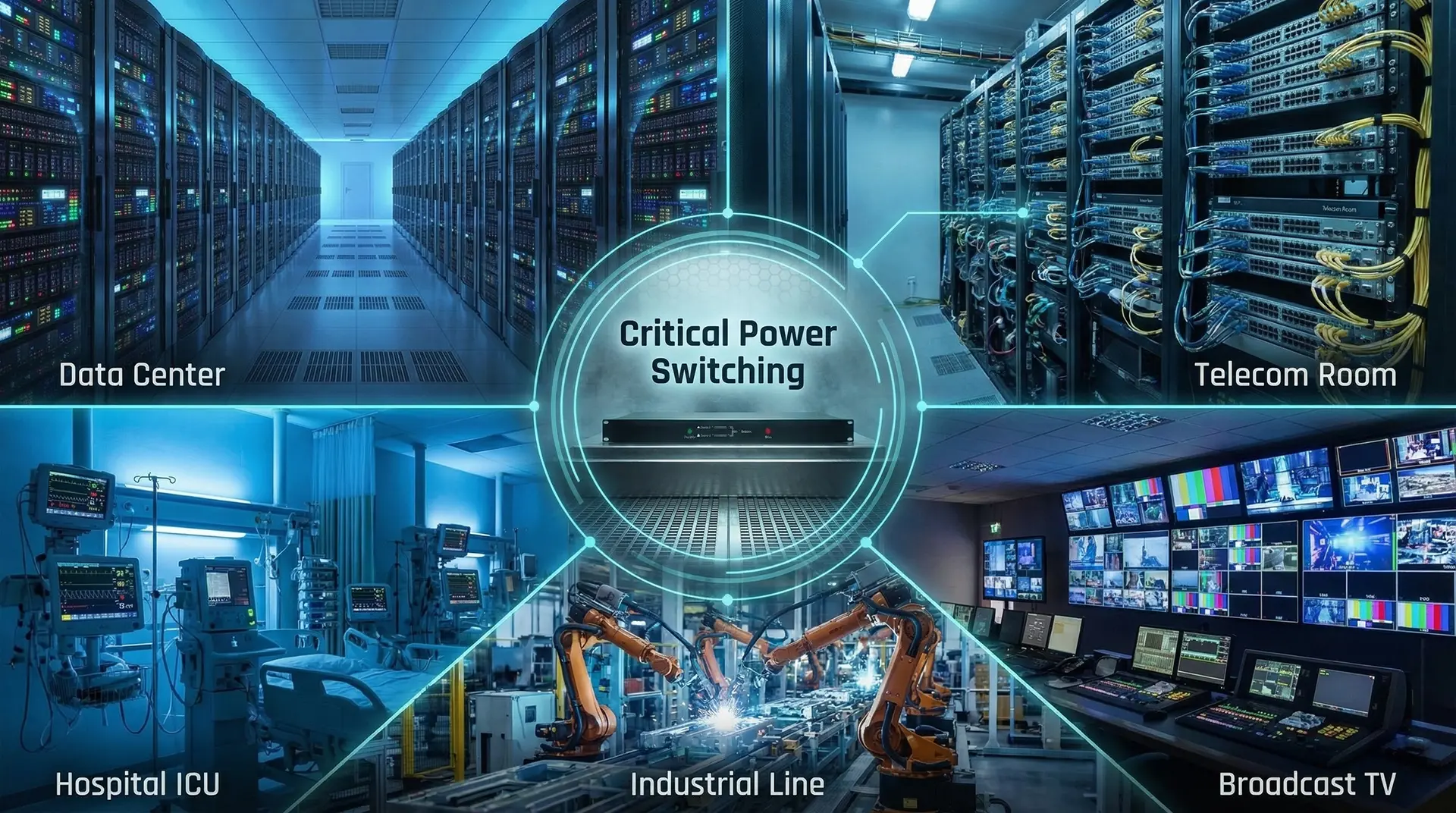
| Data Center | 🖥️ | Provides dual-power redundancy switching for servers and network equipment, ensuring business continuity; transfer time <4ms meets IT equipment requirements |
|---|---|---|
| Communication Core Equipment Room | 📡 | Dual-power supply for critical communication equipment, avoiding single points of failure and ensuring smooth communication network operation |
| Hospital Operating Room / ICU | 🏥 | Life support equipment has extremely high requirements for power supply continuity; STS fast transfer ensures uninterrupted equipment operation |
| Broadcast Television Transmission System | 📺 | Power failure of broadcasting equipment can cause on-air incidents; STS provides reliable dual-power protection |
| Industrial Automation Production Line | 🏭 | Dual-power supply for critical PLCs and control systems, preventing production losses caused by unexpected power outages |
What is the difference between an STS and a UPS?
A UPS provides battery backup power to address issues caused by prolonged power outages; an STS facilitates rapid switching between two power sources, ensuring instantaneous transfer in the event of a failure in one source. It is typically used in conjunction with two independent utility power feeds or two separate UPS units.
Is a switching time of <4ms sufficient to meet server requirements?
Yes. Server power supplies are typically capable of tolerating power interruptions of 10–20ms; therefore, a switching time of <4ms is more than sufficient to ensure that servers do not restart during the transfer.
How do I choose between the single-phase and three-phase versions?
Select the version based on the power requirements of your load. Choose the single-phase version for single-phase loads (e.g., standard servers, low-power devices), and the three-phase version for three-phase loads (e.g., large data centers, industrial equipment).
Does it support manual switching?
Yes. Manual forced switching can be performed via buttons on the front panel or through remote communication interfaces, facilitating maintenance and testing procedures.
How is remote monitoring achieved?
The unit comes standard with RS485 communication and dry contact outputs; an optional SNMP card is also available to integrate the device into a dynamic environment monitoring system.
What does "Break-Before-Make" (BBM) mean?
During a transfer, the current power source is disconnected *before* the backup power source is connected. This ensures that the two power sources are never momentarily paralleled, thereby preventing circulating current faults.